
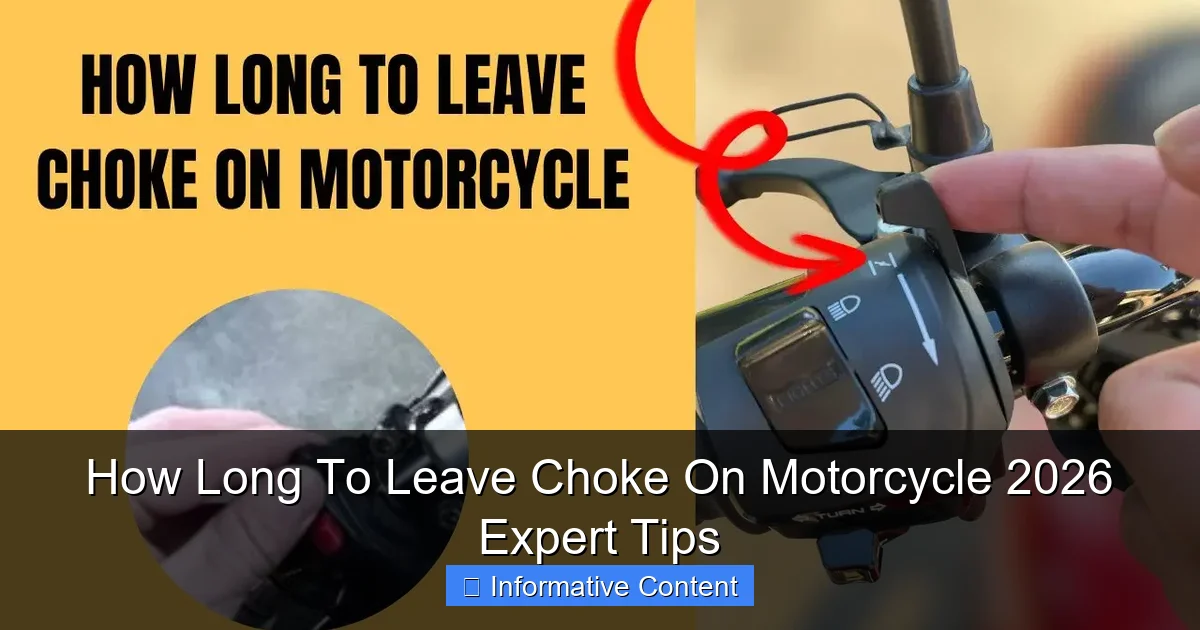
Mastering how long to leave choke on your motorcycle is crucial for engine health and smooth starts. It depends on factors like temperature and engine type, requiring careful listening to your bike’s cues. Gradually reducing the choke as the engine warms up prevents damage, saves fuel, and ensures optimal performance, regardless of whether your bike has a manual lever or an automatic cold-start system.
How Long To Leave Choke On Motorcycle 2026 Expert Tips
Hey there, fellow rider! You’ve just thrown a leg over your trusty machine, the air is a bit crisp, and you’re ready to hit the road. But before you twist that throttle, there’s a crucial little lever (or perhaps a sophisticated electronic system) that deserves your attention: the choke. Understanding how long to leave choke on motorcycle is more than just a quick flick of a switch; it’s an art, a science, and a fundamental aspect of proper motorcycle care and riding etiquette.
In the year 2026, while many modern bikes boast advanced Electronic Fuel Injection (EFI) systems that handle cold starts automatically, a significant portion of the motorcycles on our roads still rely on manual or semi-automatic choke mechanisms. Even with EFI, the *principle* of cold-start enrichment remains. Whether you’re riding a classic cruiser, a dirt bike, or a modern street machine, knowing the ins and outs of your motorcycle’s cold-start procedure is vital for engine longevity, fuel efficiency, and a smooth departure every time.
This comprehensive guide will dive deep into everything you need to know about your motorcycle’s choke. We’ll explore its purpose, the factors influencing its use, and expert tips to ensure you’re using it just right. So, let’s gear up and learn how to master the art of the cold start, ensuring your ride is always ready for the adventures ahead!
Key Takeaways
- Understand the Choke’s Purpose: The choke enriches the fuel-air mixture, making it easier for a cold engine to start and run smoothly until it reaches operating temperature.
- Listen to Your Motorcycle: The most reliable indicator for how long to leave choke on your motorcycle is your bike’s engine sound and idle stability. Reduce choke as the engine smooths out.
- Factors Affecting Duration: Ambient temperature, engine size, carbureted versus modern EFI systems, and even altitude significantly impact how long the choke is needed. Colder temperatures mean longer choke usage.
- Gradual Reduction is Key: Don’t just flip the choke off. Slowly push it in as the engine warms, typically through stages, to avoid stalling and ensure a smooth transition.
- Modern Bikes and “Choke”: While most new motorcycles (post-2010s) use Electronic Fuel Injection (EFI) with automatic cold-start enrichment, the *principle* of needing a richer mixture for cold starts still applies, even without a physical choke lever.
- Avoid Common Mistakes: Leaving the choke on too long wastes fuel, fouls spark plugs, and can damage engine components. Not using it enough leads to difficult starts and stalling.
- Prioritize Engine Health: Proper choke usage is a fundamental skill for motorcycle longevity, fuel efficiency, and rider safety.
Quick Answers to Common Questions
How does a choke work on a motorcycle?
A choke works by restricting the amount of air entering the engine’s carburetor, creating a richer fuel-air mixture. This richer mixture is easier to ignite and helps a cold engine start and run smoothly until it warms up.
Can I ride my motorcycle with the choke on?
While you can briefly ride with the choke partially on, it is generally not recommended. Riding with the choke on too long wastes fuel, can foul spark plugs, and may cause long-term engine damage.
What are the signs that my motorcycle needs less choke?
Signs that your motorcycle needs less choke include an excessively high idle speed, the engine sounding rough or bogging down, a strong smell of fuel from the exhaust, or visible blue/black smoke.
Do EFI motorcycles have a choke?
Most modern EFI (Electronic Fuel Injection) motorcycles do not have a manual choke lever. Instead, the engine’s ECU (Engine Control Unit) automatically enriches the fuel mixture during cold starts, acting as an automatic choke.
How long should a motorcycle warm up with the choke on?
The warm-up time with the choke on varies, but typically ranges from 30 seconds to 3 minutes. Listen for a stable, smooth idle and the ability to blip the throttle without stalling as indicators to gradually reduce or turn off the choke.
📑 Table of Contents
- Understanding the Choke: Your Engine’s Cold Start Assistant
- Factors Influencing Choke Usage: It’s Not One-Size-Fits-All
- The Goldilocks Zone: Optimal Choke Duration
- Modern Motorcycles and the “Choke”: A 2026 Perspective
- Common Mistakes and How to Avoid Them
- Advanced Tips for Choke Management and Engine Health
- Conclusion: The Art of the Perfect Cold Start
Understanding the Choke: Your Engine’s Cold Start Assistant
To properly use your motorcycle’s choke, you first need to understand what it actually does. Think of it as a helpful assistant that makes your engine “feel better” when it’s chilly outside.
What Exactly is a Choke?
On most carbureted motorcycles, the choke is a mechanical device that restricts the amount of air entering the engine’s carburetor. By reducing the airflow, it creates a “richer” fuel-air mixture. This means there’s a higher proportion of fuel relative to air. Why is this important? When an engine is cold, gasoline doesn’t vaporize as easily. A richer mixture ensures enough fuel vapor reaches the combustion chambers to ignite and start the engine, even in colder conditions. Without a choke, a cold engine would struggle to start, often requiring excessive cranking and potentially draining your battery.
Choke vs. Enrichener Valve: A Modern Nuance
While we often use the term “choke,” many modern carbureted motorcycles, especially those from the late 90s and early 2000s, actually use an “enrichener valve” or “starter valve.” Instead of restricting air, this system adds extra fuel directly to the intake. The effect is largely the same – a richer mixture for cold starts – but the mechanism is different. For practical purposes, you can still refer to these systems as “chokes” because their function for the rider is identical: pull the lever for cold starts. Even on EFI bikes, the ECU provides more fuel during cold starts, acting as an automatic choke.
Factors Influencing Choke Usage: It’s Not One-Size-Fits-All

Visual guide about How Long To Leave Choke On Motorcycle 2026 Expert Tips
Image source: simplymotorcycle.com
There’s no single, universal answer to how long to leave choke on motorcycle. Many variables come into play. Being aware of these will help you fine-tune your approach.
Ambient Temperature: The Primary Driver
This is the biggest factor. On a freezing winter morning, your engine will need the choke on for a significantly longer period than on a mild spring day. The colder the air, the harder it is for fuel to vaporize, and thus, the more enrichment (choke) your engine will require. In tropical climates, you might only need the choke for a few seconds, or not at all. In sub-zero temperatures, it could be minutes.
Engine Type and Size: Carbureted vs. EFI
- Carbureted Engines: These are the classic “choke” users. They rely directly on the choke lever to adjust the fuel-air mixture. Older or larger displacement carbureted engines might have a more pronounced need for the choke.
- Electronic Fuel Injection (EFI): Most new motorcycles in 2026 are EFI. These systems typically don’t have a manual choke lever. Instead, sensors (like engine temperature sensors) feed data to the engine’s Electronic Control Unit (ECU). The ECU then automatically adjusts the fuel delivery to enrich the mixture during cold starts, effectively acting as an “automatic choke.” While you don’t physically control it, the *principle* of needing a richer mixture for cold starts still applies. You’ll often hear the idle speed rise automatically during a cold start on an EFI bike.
Engine Condition and Age
An older engine with some wear, or one that hasn’t been serviced recently, might be a bit more finicky. Worn piston rings, dirty spark plugs, or a clogged air filter can all affect how easily your engine starts and how long it needs the choke. A well-maintained, newer engine will typically start more easily and require less choke time.
Altitude Considerations
At higher altitudes, the air is thinner, meaning there’s less oxygen. A standard fuel-air mixture that works well at sea level might be too rich at higher elevations. This means you might need less choke, or for a shorter duration, at higher altitudes compared to sea level, even on a cold day. Conversely, a bike tuned for high altitude might struggle at sea level without careful choke management.
The Goldilocks Zone: Optimal Choke Duration
The goal is to use just enough choke for just long enough. Not too much, not too little, but *just right*. This “Goldilocks Zone” is where your engine starts smoothly, warms up efficiently, and isn’t stressed.
Listen to Your Engine: The Best Indicator
Your motorcycle’s engine is incredibly communicative. It will tell you when it’s happy and when it’s not.
- When to Engage the Choke: For a truly cold start (engine has been off for hours, especially in cool weather), always start with the choke fully on or at its highest setting.
- Starting the Engine: Press the starter button. The engine should fire up and settle into a fast idle. This elevated idle speed is normal when the choke is engaged.
- The Gradual Reduction: As the engine starts to warm up, you’ll notice a change in the sound. The idle speed will increase even further, and the engine might sound a bit “rough” or “lumpy” if the choke is still fully engaged. This is your cue to start reducing the choke.
- Staged Reduction: Many choke levers have multiple positions. Instead of simply flipping it off, try reducing it in stages (e.g., halfway, then fully off). Each time you reduce it, listen to the engine. If the idle speed drops significantly and the engine sounds like it’s about to stall, you’ve gone too far too soon. Pull the choke back out slightly until the idle stabilizes again.
- When to Turn it Off Completely: The choke can usually be turned off entirely when the engine idles smoothly on its own at its normal idle speed (check your owner’s manual for the specific RPM). You should be able to blip the throttle without the engine bogging down or stalling. This usually takes between 30 seconds to 3 minutes, depending on the temperature and your bike.
Signs of Too Much Choke
- Excessively High Idle: The engine is screaming beyond its usual fast-choke idle.
- Rough Running/Bogging: The engine sounds like it’s struggling, or when you twist the throttle, it bogs down or hesitates.
- Rich Exhaust Smell: You might smell unburnt fuel from the exhaust.
- Blue/Black Smoke: This is a strong indicator of an overly rich mixture.
If you notice these signs, reduce the choke immediately. Leaving too much choke on can foul your spark plugs, dilute your engine oil with unburnt fuel, and contribute to carbon buildup.
Signs of Not Enough Choke
- Difficulty Starting: The engine cranks but doesn’t catch, or struggles to fire up.
- Stalling Immediately After Starting: The engine fires but quickly dies.
- Low, Unstable Idle: The engine starts but idles very low and unevenly, threatening to stall.
- Needs Constant Throttle Input: You have to keep twisting the throttle to keep it running.
If your bike exhibits these symptoms, try adding a bit more choke until the idle stabilizes.
Modern Motorcycles and the “Choke”: A 2026 Perspective
As of 2026, the motorcycle landscape is dominated by Electronic Fuel Injection (EFI). This means that for many new riders, the concept of a physical choke lever is an unfamiliar one. However, the underlying principle of cold-start enrichment remains crucial.
EFI and Automatic Cold Start Enrichment
On an EFI motorcycle, the ECU (Engine Control Unit) is the brain. When you turn the key, sensors measure engine temperature, air temperature, and other parameters. If the engine is cold, the ECU automatically commands the fuel injectors to deliver a richer fuel mixture and often increases the idle speed. This is your “automatic choke” in action.
What to Expect with EFI
- Higher Initial Idle: You’ll typically hear the engine rev higher than normal immediately after starting, especially on a cold morning. This is normal.
- Gradual Idle Reduction: As the engine warms, the ECU gradually reduces the fuel enrichment and lowers the idle speed to its normal operating range. You don’t have to do anything!
- Still Need Patience: Even with EFI, it’s wise not to just start and immediately rev the engine hard. Give the engine a minute or two to warm up properly, allowing the oil to circulate and reach optimal temperature.
The Enduring Relevance for Carbureted Bikes
Despite the prevalence of EFI, millions of carbureted motorcycles are still on the road globally. Many riders cherish older models, off-road bikes, or niche machines that continue to use carburetors. For these bikes, the manual choke remains an essential component. Owners of these bikes must still master how long to leave choke on motorcycle for reliable performance and engine health.
Common Mistakes and How to Avoid Them
Misusing the choke is a common pitfall for new and experienced riders alike. Knowing these mistakes can save you headaches and repair bills.
1. Leaving the Choke On Too Long
This is perhaps the most common mistake.
- Consequences:
- Wasted Fuel: A rich mixture burns more fuel.
- Fouled Spark Plugs: Unburnt fuel can deposit carbon on your spark plugs, leading to misfires and poor performance.
- Carbon Buildup: Excess fuel can lead to carbon deposits in the combustion chamber.
- Engine Oil Dilution: Unburnt fuel can wash past piston rings and contaminate your engine oil, reducing its lubricating properties and potentially causing premature engine wear.
- Increased Emissions: Not great for the environment or your bike’s exhaust system.
- How to Avoid: Listen to your engine! Reduce the choke as soon as the idle stabilizes and the engine sounds smooth. Make it a habit to gradually push it in during your pre-ride checks or while you’re putting on your helmet.
2. Not Using Enough Choke (or Any at All)
Equally detrimental is failing to provide enough enrichment for a cold engine.
- Consequences:
- Hard Starting: Engine struggles to fire, leading to excessive cranking and battery drain.
- Stalling: Engine starts but immediately dies.
- Engine Strain: Running a cold engine on a lean mixture can cause internal stress.
- Frustration: Plain and simple, it’s annoying when your bike won’t start easily.
- How to Avoid: For cold starts, always start with full choke. If the engine struggles, ensure the choke is fully engaged. Adjust as needed.
3. Revving Excessively with Choke On
Some riders think revving the engine with the choke on will warm it up faster. This is generally a bad idea.
- Consequences:
- Flooding: Especially on carbureted bikes, excessive revving with a rich mixture can flood the engine.
- Unnecessary Wear: High RPMs on a cold engine with thick oil can cause undue stress and wear on internal components.
- Poor Fuel Economy: You’re just dumping fuel into the exhaust.
- How to Avoid: Let the engine warm up gently with the choke. A fast idle is normal and sufficient for warming. Save aggressive revving for when the engine is fully warmed and the choke is off.
4. Forgetting to Turn the Choke Off Before Riding
Many riders get distracted and forget the choke is still on when they pull away.
- Consequences: All the negative effects of leaving the choke on too long, but compounded by riding under load. Your bike will feel sluggish, consume excessive fuel, and potentially foul plugs rapidly.
- How to Avoid: Make checking the choke a part of your pre-ride routine. Before you engage first gear, glance at your choke lever. If your bike has a choke warning light, pay attention to it!
Advanced Tips for Choke Management and Engine Health
Beyond the basics, a few extra tips can help you optimize your choke usage and ensure your motorcycle runs like a dream for years to come.
Know Your Bike’s Personality
Every motorcycle is unique. One bike might be perfectly happy with its choke off after 60 seconds, while another needs a full two minutes. Spend time with your motorcycle, learn its sounds, and understand its specific needs. Pay attention to how it responds to temperature changes and your choke adjustments. This intimate knowledge is the hallmark of an expert rider.
Practice Gradual Reduction
As mentioned, don’t just “flick” the choke off. Try to reduce it in small increments. On many bikes, the choke lever has detents or specific positions that allow for partial choke. Use these! Reducing the choke in stages allows the engine to adapt smoothly to a leaner mixture as it warms, preventing stalling or an abrupt drop in idle speed.
Consider Your Riding Environment
If you live in a cold climate and regularly ride in freezing temperatures, you might consider an engine block heater or even a battery tender. While not directly related to the choke, these accessories can significantly improve cold starting and reduce the overall need for extended choke usage, especially for bikes stored outdoors.
Regular Maintenance is Key
A well-maintained motorcycle will always start and run better.
- Spark Plugs: Replace them regularly according to your manufacturer’s schedule. Clean, properly gapped plugs ignite fuel efficiently.
- Air Filter: A clean air filter ensures optimal airflow. A clogged filter can make your bike run rich, almost like having the choke partially on.
- Carburetor/Fuel System: If you have a carbureted bike, ensure the carburetors are clean and properly synchronized. For EFI bikes, keep your fuel system clean with quality fuel and occasional fuel system cleaners if recommended.
- Battery Health: A strong battery is crucial for quick cold starts, especially when the engine needs a bit more cranking with the choke on.
The “Ride Off Choke” Method (Use with Caution)
Some riders, especially on older bikes, will put the bike in gear and ride off with the choke still partially on, gradually pushing it in as they ride. While this can work, it’s generally not recommended for prolonged use as it falls into the “leaving choke on too long” category. It can be useful for avoiding stalling in very specific, quick scenarios, but aim to have the choke fully off before you begin your journey for optimal performance and engine health.
Conclusion: The Art of the Perfect Cold Start
Understanding how long to leave choke on motorcycle is an essential skill for any rider, regardless of your bike’s age or technology level in 2026. It’s not about following a rigid timetable, but rather about developing an intuitive understanding of your bike’s needs. By listening carefully to your engine, considering environmental factors, and avoiding common mistakes, you’ll ensure your motorcycle starts smoothly, warms up efficiently, and delivers reliable performance for every ride.
Treat your choke like the fine-tuning instrument it is. Master its use, and you’ll not only prolong your engine’s life but also enhance your riding experience, ensuring that every journey begins with a confident, purring engine ready to tackle the road ahead. Happy riding!
Frequently Asked Questions
What is the main purpose of a motorcycle choke?
The main purpose of a motorcycle choke is to provide a richer fuel-air mixture to the engine during cold starts. This compensates for fuel that doesn’t vaporize well in cold temperatures, allowing the engine to start and run smoothly until it reaches its optimal operating temperature.
Is it bad to leave the choke on for too long?
Yes, leaving the choke on for too long is detrimental. It can lead to excessive fuel consumption, fouled spark plugs, carbon buildup in the engine, dilution of engine oil with unburnt fuel, and increased exhaust emissions, potentially causing long-term engine wear.
How do I know when to turn the choke off completely?
You know when to turn the choke off completely when your engine idles smoothly and consistently at its normal operating RPM, without needing any throttle input, and responds cleanly when you briefly blip the throttle. This usually means the engine has warmed up sufficiently.
Does ambient temperature affect choke usage?
Absolutely. Ambient temperature is a primary factor. Colder temperatures require the choke to be on for a longer duration to provide sufficient fuel enrichment, while warmer temperatures may require very little or no choke at all.
Can a dirty carburetor affect my choke usage?
Yes, a dirty or poorly maintained carburetor can significantly affect choke usage. Clogged jets or passages can make the engine run either too lean or too rich, requiring you to compensate with improper choke settings and making cold starting more difficult and less predictable.
What should I do if my motorcycle stalls when I reduce the choke?
If your motorcycle stalls when you reduce the choke, it indicates that the engine is not yet warm enough to run on a leaner mixture. Pull the choke back out slightly, restart the engine, and allow it to warm up for a little longer before attempting to reduce the choke again, this time in smaller increments.