How Does a Motorcycle Phone Mount Work?

I still remember the first time my phone flew off my handlebars on the highway. I was riding my cruiser, trying to use a map. I hit a bump. My phone popped out of a cheap plastic holder and smashed on the road. That mistake cost me a lot of money. It also taught me a huge lesson about motorcycle gear.
As a lifelong rider, I know how much we rely on our phones today. We need them for GPS directions. We use them to control music. We keep them handy for emergencies. But motorcycles vibrate a lot. They bounce over potholes. The wind tries to rip everything away. You need a way to keep your phone safe while you ride.
So, how does a motorcycle phone mount actually hold your device safely at highway speeds? Let me explain exactly how these mounts grip your phone, handle the wind, and protect your camera from engine shaking. It is easier to understand than you might think.
Quick Answer
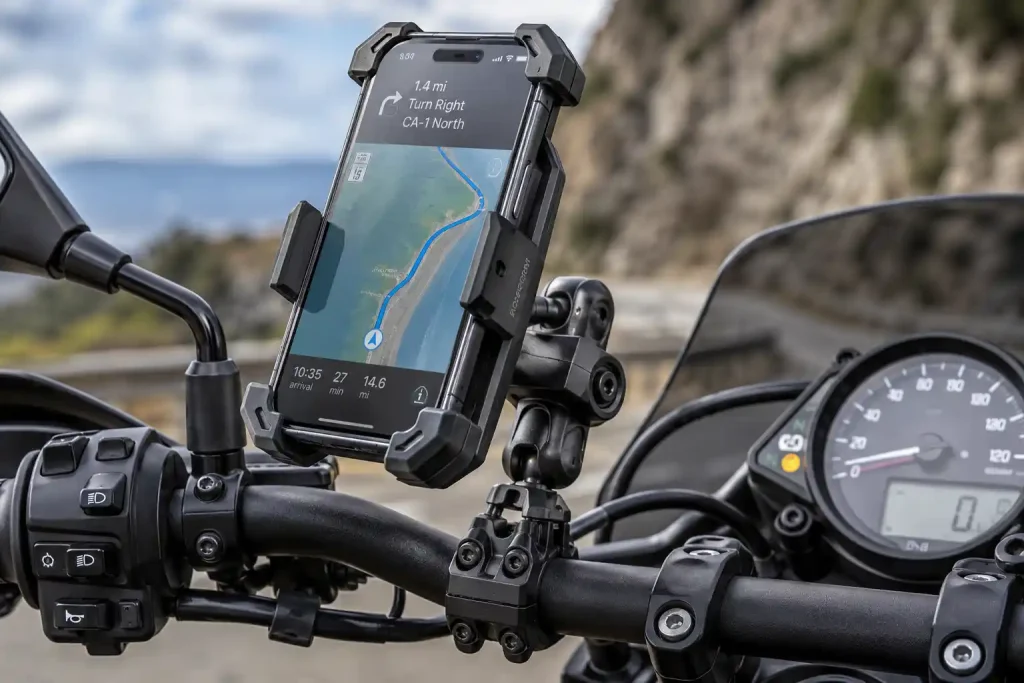
A motorcycle phone mount works by using mechanical force to grip your phone and lock it to your bike. Most mounts use a strong metal clamp, heavy-duty springs, or a molded locking case to hold the phone tight. The base of the mount wraps around your handlebars or stem nut to keep the unit firmly attached to the motorcycle. High-quality mounts also use rubber shock absorbers to soak up engine vibrations so they do not break your phone camera.
How the Holding Mechanisms Actually Work
You might wonder how a small piece of metal or plastic can hold a heavy phone at 70 miles per hour. It comes down to basic physics. Different brands use different designs, but they all share the same goal. They must grip the phone without crushing it.
Here are the three main ways a phone mount grips your device:
- Spring-Loaded Clamps: These mounts use strong metal springs. When you push your phone into the mount, the springs open. When you let go, the springs snap shut. They squeeze the sides or corners of your phone. The tension is very strong. The phone cannot slip out.
- Screw-Lock Clamps: These mounts have a knob on the side. You put your phone in the cradle. Then, you twist the knob. This turns a metal screw that pushes the side walls together. It locks the phone in place like a vice. It is very secure.
- Proprietary Locking Cases: Some systems require you to buy a special phone case. The back of the case has a built-in locking ring. You push the phone onto the mount and twist it 90 degrees. It clicks into place. It cannot come off until you push a release lever and twist it back.
All of these methods work well. The best choice depends on how fast you want to attach and remove your phone. I personally love the twist-and-lock cases for quick stops.
How Vibration Affects Your Phone (And How Mounts Fix It)
Here is the thing. Holding the phone is only half the job. A good mount must also protect your phone from your motorcycle engine. This is a very big deal in 2026. Modern smartphones have amazing cameras. But these cameras use tiny, moving parts called Optical Image Stabilization (OIS).
When you ride, your motorcycle engine shakes. This is especially true at high RPMs. That high RPM rattling travels right up the forks and into the handlebars. If your phone is attached straight to the metal bars, that high-frequency vibration shakes the phone camera to death. It breaks the tiny OIS parts. Your camera will stop focusing. It will just take blurry photos forever.
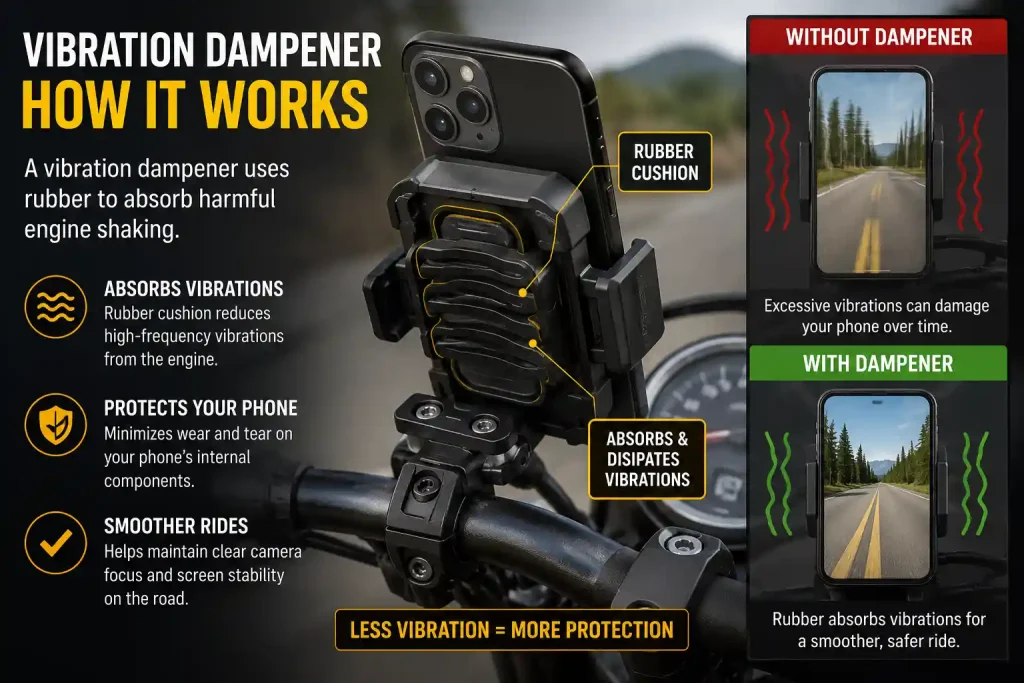
To stop this, modern phone mounts use vibration dampeners. A dampener is a small shock absorber. It sits between the clamp on the handlebars and the cradle holding the phone. It is usually made of soft, flexible rubber or silicone.
When the bike rattles at high RPM, the rubber wiggles and absorbs the energy. The phone floats gently above the shaking. This keeps your expensive camera safe from the harsh vibrations of the road. If you buy a mount, you must make sure it has a vibration dampener.
| Feature | Standard Phone Mount | Vibration-Damping Mount |
|---|---|---|
| Grips Phone tightly? | Yes | Yes |
| Attaches to Handlebars? | Yes | Yes |
| Protects Camera OIS? | No | Yes |
| Handles High RPM Rattling? | Poorly | Excellent |
| Cost | Cheaper | More Expensive |
How to Tell Where a Mount Fits Your Motorcycle
Not all motorcycles are built the same. A sportbike looks very different from a big cruiser. Because of this, you cannot put a handlebar mount on every single bike. You need to look at your motorcycle and see where the mount can attach.
Here are the most common ways a mount attaches to your motorcycle:
- Handlebar Clamps: This is the most common. It is a metal ring that wraps around the round metal tube of your handlebars. It uses screws to tighten down. This works great on cruisers, naked bikes, and adventure motorcycles.
- Stem Nut Mounts: Sportbikes often do not have round handlebars. They have clip-ons. But they do have a hollow hole in the center of the steering stem. A stem mount drops into this hole. You tighten a bolt, and the mount expands inside the hole to lock itself in place.
- Mirror Mounts: Scooters and some older bikes do not have extra space on the bars. A mirror mount bolts directly onto the stem of your rearview mirror. It keeps the phone high and easy to see.
- Brake or Clutch Reservoir Mounts: These bolt directly over the fluid reservoirs on your handlebars. They replace the factory screws with longer screws holding the mount base. This saves a lot of space.
Always check your bike before you buy. Measure your handlebars. Most bars are 7/8 inch, 1 inch, or 1.25 inches thick. You need a mount that fits that exact size.
How to Install a Motorcycle Phone Mount Step by Step
Installing a mount is usually an easy DIY job. You do not need a mechanic. You just need a few basic tools and about ten minutes. Let me walk you through the safest way to do it.
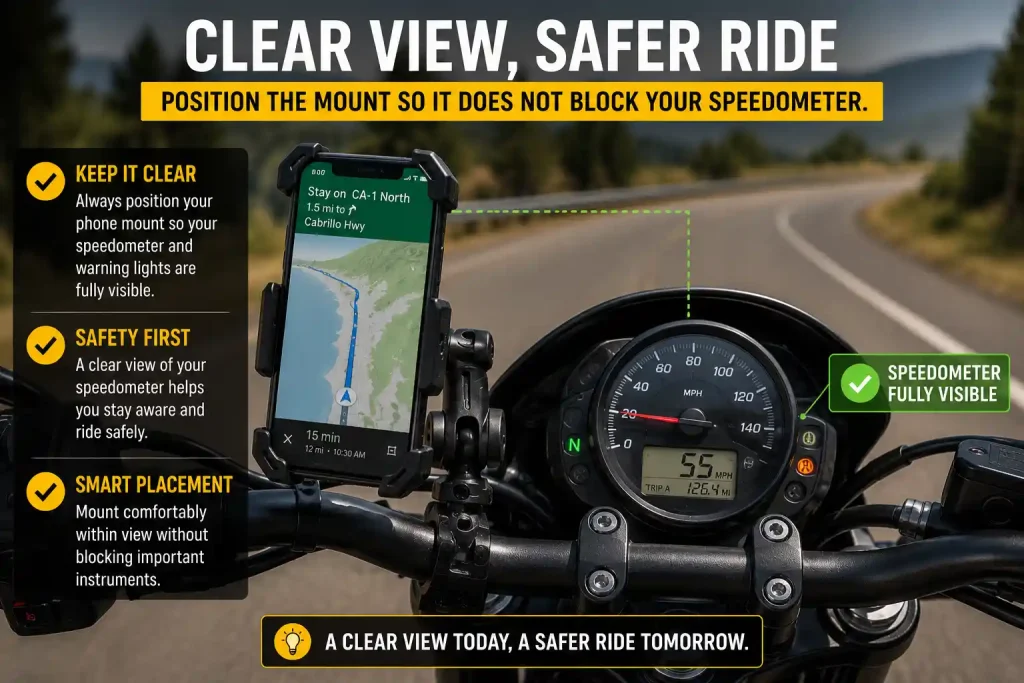
- Find the best spot: Sit on your motorcycle. Hold your phone over the handlebars. Find a spot where it does not block your speedometer. Make sure it does not hit your gas tank when you turn the handlebars all the way to the left and right.
- Clean the mounting area: Wipe the metal handlebar with a clean rag. Dirt and grease can make the mount slip around later.
- Add the rubber spacer: Most mounts come with thin rubber strips. Wrap one strip around the metal bar. This protects the chrome or paint from scratches. It also adds grip so the mount will not spin.
- Attach the base clamp: Put the metal clamp over the rubber spacer. Insert the screws. Use an Allen wrench to tighten them. Tighten them evenly. Do not overtighten, or you might strip the screws.
- Attach the arm and cradle: Connect the arm to the base ball joint. Then, attach the phone cradle to the arm. Leave the knobs slightly loose.
- Adjust the angle: Put your phone in the cradle. Sit on the bike again. Adjust the screen so you can see it easily without tilting your head down too much. Make sure the sun will not create a bad glare.
- Lock it down: Once the angle is perfect, tighten the main knob hard. Your mount is now ready to use.
Common Mistakes to Avoid When Using a Phone Mount
I have seen a lot of riders make simple mistakes with their mounts. These mistakes can cost you your phone, or worse, cause a crash. Avoid doing these things:
- Ignoring the safety tether: Many spring-loaded mounts come with a rubber web that stretches over the corners of your phone. Always use it. The springs can fail on a big pothole. The rubber tether will save your phone.
- Looking at the phone too long: A mount is for quick glances at a map. Never stare at your phone while moving. According to the NHTSA, taking your eyes off the road for even a few seconds is incredibly dangerous.
- Forgetting to use threadlocker: Motorcycle vibrations shake screws loose. Put a tiny drop of blue threadlocker liquid on the mount screws before you install them. This stops them from vibrating out on the highway.
- Leaving the mount loose: If your mount spins on the handlebars when you push it, it is too loose. The wind at 70 mph pushes hard. It will fold your phone down flat if the clamp is not tight.
- Using cheap plastic mounts: Do not buy a ten-dollar mount for a thousand-dollar phone. Cheap plastic gets brittle in the sun. It will snap. Always buy mounts made from marine-grade aluminum or high-density composite materials.
Expert Tips from Robert
After years of riding in the rain, the heat, and the dirt, I have learned a few tricks. I want to share them with you so you get the most out of your gear.
Robert’s Tip: Beware the Sun
Your phone will get very hot sitting out in the sun while running GPS. On hot summer days, the sun combined with the screen heat can cause your phone to overheat and shut off. Try to angle the mount so your body blocks the sun, or take off your heavy phone case to let it cool down in the wind.
Robert’s Tip: Route Your Charger Carefully
If you plug your phone in while riding, make sure the charging cable is tied down. A loose cable will flap violently in the wind. It will whip against your paint and leave deep scratches. Use zip ties or velcro straps to secure the cable to the handlebars.
Robert’s Tip: Touchscreen Gloves Matter
If you have a phone mount, you still need to tap the screen sometimes at a red light. Taking off your glove is annoying. Always buy motorcycle gloves with touch-sensitive fingertips. It makes using your mounted phone much easier.
Key Takeaways
- Motorcycle phone mounts work by using strong clamps, springs, or locking cases to grip your device safely.
- Engine vibration at high RPMs can destroy modern phone cameras. You must use a mount with a rubber vibration dampener.
- Mounts attach in different ways. Check if your bike needs a handlebar mount, stem mount, or mirror mount before buying.
- Always install the mount securely using rubber spacers to protect your handlebars from scratches and to stop slipping.
- Never stare at your mounted phone while riding. Use it only for quick glances at GPS directions to stay safe on the road.
Frequently Asked Questions
Do motorcycle phone mounts ruin your phone camera?
Yes, they can. High-frequency vibrations from the motorcycle engine can break the tiny optical image stabilization parts inside modern phone cameras. You can prevent this by using a mount that features a built-in vibration dampener.
What is the safest type of motorcycle phone mount?
The safest mounts are made from solid aluminum and use either a strong screw-clamp mechanism or a proprietary twist-and-lock case system. Always pair them with a rubber vibration dampener and a safety tether for maximum security.
Where is the best place to put a phone mount on a motorcycle?
The best place is high up on the handlebars, close to your line of sight, but without blocking your speedometer or mirrors. You want to be able to glance at it without fully looking down.
Will a phone mount scratch my handlebars?
Not if you install it correctly. Quality mounts come with a thin strip of rubber. You wrap this rubber around the metal bar before clamping the mount over it. This protects the metal from scratches.
Can my phone fall out of a motorcycle mount?
If you use a high-quality mount and secure it properly, your phone will not fall out. However, if you forget to use the rubber safety tether on a spring-loaded mount, a very hard bump could potentially knock it loose.
Can I use a bicycle phone mount on a motorcycle?
No, you should never do this. Bicycle mounts are made from thin plastic. They cannot handle the extreme wind speeds or the intense engine vibrations of a motorcycle. They will break and drop your phone.
Keeping your phone safe on a motorcycle is all about picking the right tool for the job. You do not want to risk an expensive smartphone on a cheap plastic holder. Invest in a mount made of strong metal. Make absolutely sure it has a rubber vibration dampener to fight off that high RPM rattling. Take ten minutes to bolt it down tight.
The good news is that once you set it up right, you never have to worry about it again. You can just snap your phone in place, load up your favorite curvy road on the map, and enjoy the ride. Just remember to keep your eyes on the road ahead.
If you want to read more about setting up your bike for long trips, check out our guide on Motorcycle Touring Accessories to learn what else you need to ride comfortably.