H6 Vs H7 Vs H8 Battery: Ultimate Comparison for 2026

Choosing the right battery for your vehicle can feel confusing, especially when you see options like H6, H7, and H8. You want a battery that fits perfectly, lasts long, and keeps your car running smoothly.
But how do you know which one suits your needs best? This article will clear up the mystery. By the end, you’ll understand the key differences between H6, H7, and H8 batteries, helping you make a smart choice that saves you time and money.
Ready to find the perfect match for your car? Keep reading!

Credit: www.jinftry.com
Battery Types Comparison
Choosing the right automotive power source is key for your vehicle’s performance. The H6, H7, and H8 batteries each offer unique car battery features. Understanding their differences helps with making smart decisions. This battery types comparison covers the main points about these automotive battery types. It explains battery capacity differences, size compatibility, and vehicle battery performance. This guide simplifies the car battery comparison for you.
H6 Battery Features
The H6 battery specifications make it a popular choice for many mid-sized vehicles. It is known for its compact size and reliable power output. The H6 battery fits well in smaller engine compartments, making it ideal for compact cars and some SUVs.
- Battery Size Compatibility: The H6 battery measures approximately 9.1 x 6.9 x 7.5 inches.
- Battery Capacity Differences: It offers a capacity around 48-60 Ah (Ampere-hours), suitable for moderate power needs.
- Vehicle Battery Performance: The H6 provides steady cranking power and good reserve capacity for daily driving.
Below is a quick comparison of H6 battery specifications:
| Feature | Specification |
|---|---|
| Size (L x W x H) | 9.1 x 6.9 x 7.5 inches |
| Capacity | 48-60 Ah |
| Cold Cranking Amps (CCA) | 550-650 |
H6 batteries balance size and power, making them a solid choice for many vehicles.
H7 Battery Features
The H7 battery specifications suit larger vehicles requiring more power. This battery type is common in trucks and SUVs with higher engine demands. It offers improved capacity and stronger cranking power compared to H6 batteries.
- Battery Size Compatibility: The H7 battery is larger, around 11 x 6.8 x 7.5 inches.
- Battery Capacity Differences: It typically provides 70-85 Ah, supporting bigger engines and accessories.
- Vehicle Battery Performance: Delivers high cold cranking amps (CCA), ensuring quick starts even in cold weather.
The table below shows the key H7 battery specifications:
| Feature | Specification |
|---|---|
| Size (L x W x H) | 11 x 6.8 x 7.5 inches |
| Capacity | 70-85 Ah |
| Cold Cranking Amps (CCA) | 700-850 |
These car battery features make the H7 a strong choice for vehicles with higher power needs.
H8 Battery Features
The H8 battery specifications fit large trucks and commercial vehicles. It is the biggest among these automotive battery types. The H8 battery offers high capacity and excellent durability for demanding conditions.
- Battery Size Compatibility: Roughly 12.2 x 7.7 x 7.5 inches, requiring ample space.
- Battery Capacity Differences: Capacity ranges from 85 to 100 Ah or more, supporting heavy loads and long drives.
- Vehicle Battery Performance: Provides very high cold cranking amps, ensuring reliable starts in extreme climates.
Check the table below for a summary of H8 battery specifications:
| Feature | Specification |
|---|---|
| Size (L x W x H) | 12.2 x 7.7 x 7.5 inches |
| Capacity | 85-100+ Ah |
| Cold Cranking Amps (CCA) | 800-1000+ |
The H8 battery excels in power and endurance for heavy-duty vehicles.
Performance Differences
Understanding the performance differences between H6, H7, and H8 batteries helps in choosing the right battery for your vehicle. These batteries vary in power delivery, lifespan, and starting ability. Each type suits different vehicle needs and driving conditions. Comparing their features reveals key insights into vehicle battery performance and battery capacity differences.
Power Output
The battery power output is crucial for ensuring your vehicle runs smoothly. H6, H7, and H8 batteries deliver different levels of power based on their design and capacity.
- H6 Battery Specs: Typically provides moderate power output suitable for mid-sized vehicles.
- H7 Battery Features: Offers higher power output, ideal for larger vehicles or those with more electrical components.
- H8 Battery Advantages: Usually delivers the highest power output, supporting heavy-duty or high-performance vehicles.
Below is a comparison table showing typical power outputs:
| Battery Type | Voltage (V) | Capacity (Ah) | Typical Power Output (Watts) |
|---|---|---|---|
| H6 | 12 | 48-55 | 576-660 |
| H7 | 12 | 60-70 | 720-840 |
| H8 | 12 | 70-80 | 840-960 |
Choosing a battery with adequate power output ensures your car’s electrical system works without strain. The car battery comparison shows that H8 batteries suit vehicles needing more energy. H6 batteries work well for basic needs, while H7 fits between these two.
Lifespan
Battery lifespan varies across H6, H7, and H8 types due to construction and usage patterns. Understanding battery lifespan analysis helps in planning replacements.
H6 Battery Specs usually provide a lifespan of 3 to 5 years under normal conditions. They are reliable for everyday vehicles with moderate power needs.
H7 Battery Features extend lifespan slightly, ranging from 4 to 6 years. This makes them suitable for vehicles with higher energy demands and longer use cycles.
H8 Battery Advantages include a robust design offering 5 to 7 years of service. These batteries are often designed for heavy use or extreme conditions.
- Proper maintenance affects lifespan greatly.
- Temperature and driving habits influence battery health.
- Using the right battery type improves overall durability.
Here is a quick comparison of average lifespan:
| Battery Type | Average Lifespan (Years) |
|---|---|
| H6 | 3-5 |
| H7 | 4-6 |
| H8 | 5-7 |
Choosing the right battery type aligns with vehicle use and desired longevity. This automotive battery types comparison clarifies which battery fits your needs best.
Cold Cranking Amps
The cold cranking amps rating measures a battery’s ability to start an engine in cold weather. It is an essential factor in vehicle battery performance, especially in colder climates.
Here’s how H6, H7, and H8 batteries compare:
- H6 Battery Specs: Provide moderate cold cranking amps, enough for typical winter starts in mild climates.
- H7 Battery Features: Offer higher cold cranking amps, improving reliability in colder temperatures.
- H8 Battery Advantages: Deliver the highest cold cranking amps, ideal for very cold regions or engines requiring more power to start.
See the table below for typical cold cranking amps ratings:
| Battery Type | CCA Rating (Amps) |
|---|---|
| H6 | 550-650 |
| H7 | 650-750 |
| H8 | 750-850 |
Higher CCA ratings mean better engine starts in cold weather. For cold climates, H7 or H8 batteries are preferable for their improved starting power.
Compatibility Factors
Understanding compatibility factors is crucial when choosing between H6, H7, and H8 batteries. These car battery types vary in size, power, and design. Selecting the right battery ensures optimal car battery performance and avoids damage to your vehicle’s electrical system. Compatibility depends on vehicle battery compatibility, automotive power requirements, and physical fit. Each battery type has unique features that fit specific vehicles. Knowing these differences helps in making an informed choice.
Vehicle Requirements
Each vehicle demands certain automotive power requirements to run efficiently. The H6, H7, and H8 batteries serve different car models based on their power needs. Choosing the wrong battery can lead to poor performance or even failure to start the vehicle.
Key factors affecting vehicle requirements include:
- Engine size and type
- Electrical system voltage
- Starting power (Cold Cranking Amps)
- Reserve capacity for accessories
For example, a small car might work well with an H6 battery, which suits lower power needs. Larger vehicles or those with more electronics might require an H7 or H8 battery. These batteries provide higher cranking amps and longer reserve capacity.
| Battery Type | Typical Vehicle Use | Power Output (CCA) |
|---|---|---|
| H6 | Compact cars, small sedans | 550-650 |
| H7 | Mid-size cars, SUVs | 650-750 |
| H8 | Large SUVs, trucks | 750-850+ |
Matching the battery to your vehicle ensures reliable starts and better overall car battery performance.
Size And Dimensions
Battery size differences directly affect how well a battery fits in the vehicle’s battery tray. The H6, H7, and H8 batteries have distinct dimensions that must match the space available under the hood.
Incorrect size can cause installation problems or damage. It may also lead to vibration issues, which shorten battery life.
Here is a breakdown of common H6 battery specifications, H7 battery features, and H8 battery dimensions:
| Battery Type | Length (inches) | Width (inches) | Height (inches) |
|---|---|---|---|
| H6 | 9.1 | 6.9 | 7.5 |
| H7 | 10.2 | 6.9 | 7.5 |
| H8 | 11.9 | 6.9 | 7.5 |
Always measure your car’s battery tray before purchasing. This ensures the battery fits securely and maintains good contact with terminals. A proper fit supports better car battery performance and longevity.
Terminal Layout
Battery terminal configurations differ across the H6, H7, and H8 batteries. Terminal layout impacts installation ease and electrical connection quality.
Key points about terminal layout:
- Terminal position: Left or right side affects cable routing.
- Terminal type: Post size and shape must match the car’s connectors.
- Polarity: Correct positive and negative terminal placement is essential.
Here is a summary of typical terminal layouts for each battery type:
| Battery Type | Positive Terminal | Negative Terminal | Terminal Size |
|---|---|---|---|
| H6 | Right Side | Left Side | Standard Post |
| H7 | Right Side | Left Side | Standard Post |
| H8 | Right Side | Left Side | Standard Post |
Confirming terminal layout avoids cable strain and connection issues. It also helps maintain steady electrical flow for better car battery performance.
Cost Considerations
Choosing the right battery for your vehicle involves several cost considerations. The H6, H7, and H8 battery types differ in price, lifespan, and performance. Understanding these differences helps make an informed decision about automotive power sources. Cost is not just about the initial price but also about how long the battery lasts and how well it performs. Comparing H7 Battery Specifications with H6 Battery Features and H8 Battery Advantages provides clarity on which option offers better value. This section breaks down the key cost factors to help you evaluate these car battery types effectively.
Price Comparison
Price plays a vital role when choosing between H6, H7, and H8 batteries. Each battery type comes with a different cost range based on its capacity, technology, and brand. The H6 battery usually has a lower price due to its smaller size and lower capacity. The H7 battery, known for balanced power and performance, sits in the mid-price range. The H8 battery, offering the highest capacity and advanced features, tends to be the most expensive.
Here is a simple comparison table that shows typical price ranges for these batteries:
| Battery Type | Typical Price Range (USD) | Main Feature Impacting Price |
|---|---|---|
| H6 Battery | $80 – $120 | Smaller size, basic capacity |
| H7 Battery | $110 – $150 | Moderate capacity, balanced specs |
| H8 Battery | $140 – $190 | Higher capacity, advanced technology |
Factors affecting battery price include brand reputation, warranty, and technological improvements. For example, some H8 batteries offer extended warranties which may increase the initial price but reduce long-term costs. Also, seasonal demand and local availability impact the cost. Comparing the battery price comparison across trusted suppliers can help find the best deal.
Value For Money
Value for money depends on more than just the price tag. Vehicle battery performance and battery lifespan differences are crucial to consider. An expensive battery does not always mean better value if it fails sooner or underperforms. The H7 battery specifications often provide a good balance between cost and performance, making it a popular choice in automotive battery comparison.
Here are key points to evaluate car battery value for money:
- Lifespan: Longer battery life reduces replacement frequency and overall cost.
- Performance: Better power output ensures reliable starting and operation in different conditions.
- Warranty: A longer warranty can protect against early failures and repair costs.
- Compatibility: Proper fit for your vehicle avoids extra expenses on modifications or returns.
The H6 battery features suit smaller vehicles with lower energy demands, offering cost savings but shorter lifespan. The H8 battery advantages include higher capacity and durability, which often translate into longer use and fewer replacements. The H7 battery strikes a middle ground with reasonable pricing and solid performance, appealing to many drivers.
Here is a quick overview of value for money across these car battery types:
| Battery Type | Average Lifespan (Years) | Performance Rating | Warranty Period (Years) | Value for Money |
|---|---|---|---|---|
| H6 Battery | 3 – 4 | Moderate | 1 – 2 | Good for budget vehicles |
| H7 Battery | 4 – 5 | High | 2 – 3 | Balanced for most vehicles |
| H8 Battery | 5 – 6+ | Very High | 3 – 4 | Best for heavy-duty use |
Choosing the right battery involves weighing initial costs against lifespan and vehicle needs. Understanding automotive battery comparison helps pick the best option for your budget and car requirements.
Maintenance And Durability
The H6, H7, and H8 batteries serve different vehicles and needs. Understanding their maintenance and durability helps choose the right battery for long-lasting use. Proper care keeps the battery in good shape and extends its life. This section explores how these batteries differ in maintenance needs and resistance to harsh conditions.
Maintenance Needs
Each battery type has specific battery maintenance tips to follow. The H6 battery features a design that usually requires less frequent checks. It is known for stable performance, but regular inspection of terminals and fluid levels is important.
The H7 battery specifications often include sealed designs. These need very little maintenance but still benefit from occasional cleaning to prevent corrosion. Check battery voltage monthly to ensure good battery performance factors.
The H8 battery advantages include high capacity, which demands more attention. It may require more frequent fluid top-ups and terminal cleaning. Keeping it charged properly prevents early wear.
- Clean battery terminals every 3 months
- Check fluid levels in non-sealed batteries monthly
- Test battery voltage regularly for all types
- Keep battery securely mounted to avoid vibrations
| Battery Type | Maintenance Frequency | Key Care Points |
|---|---|---|
| H6 Battery | Quarterly | Check terminals, fluid levels |
| H7 Battery | Biannual | Clean terminals, check voltage |
| H8 Battery | Monthly | Top-up fluid, clean terminals |
Following these steps improves vehicle battery lifespan and prevents sudden failures. Good maintenance boosts overall battery durability and performance.
Resistance To Extreme Conditions
Extreme weather affects all car battery types. The H6 battery features moderate extreme temperature resistance. It works well in mild climates but can lose power in very cold or hot weather.
The H7 battery specifications often include better materials for heat resistance. It handles high temperatures well and resists damage from heat cycles. This makes it a reliable choice for warmer regions.
The H8 battery advantages include excellent resistance to both heat and cold. It maintains strong performance in freezing winters and hot summers. This resilience supports a longer vehicle battery lifespan under tough conditions.
- H6: Suitable for average climates, limited heat tolerance
- H7: Improved heat resistance, good cold start ability
- H8: High resistance to extreme temperatures both hot and cold
| Battery Type | Cold Weather Performance | Heat Resistance |
|---|---|---|
| H6 Battery | Moderate | Low |
| H7 Battery | Good | High |
| H8 Battery | Excellent | Excellent |
Choosing a battery with strong extreme temperature resistance improves reliability. It protects your vehicle from unexpected battery failure in harsh weather.

Credit: www.lisleapex.com
Choosing The Right Battery
Choosing the right battery for your vehicle is essential for smooth and safe driving. The H6, H7, and H8 batteries differ in size, capacity, and performance. Selecting the best one depends on your car’s needs and your budget. Understanding Battery Performance Factors and Vehicle Battery Compatibility helps avoid frequent battery replacements and car troubles. Each battery type suits different car models and electrical system demands. This guide focuses on key points to help pick the right battery for your vehicle.
Assessing Vehicle Needs
Before choosing between H6, H7, or H8 batteries, check your vehicle’s specific requirements. Every car has different Car Electrical System Requirements that influence battery choice. Consider these points:
- Battery Size Comparison: H6 is smaller than H7 and H8. Make sure the battery fits your car’s battery tray.
- Battery Capacity Differences: H8 usually offers higher capacity and longer life than H6 and H7.
- Automotive Battery Ratings: Look for Cold Cranking Amps (CCA) and Reserve Capacity (RC). Higher ratings mean better performance in cold weather and longer power supply.
- Vehicle Battery Compatibility: Check your car manual or consult a mechanic for recommended battery types.
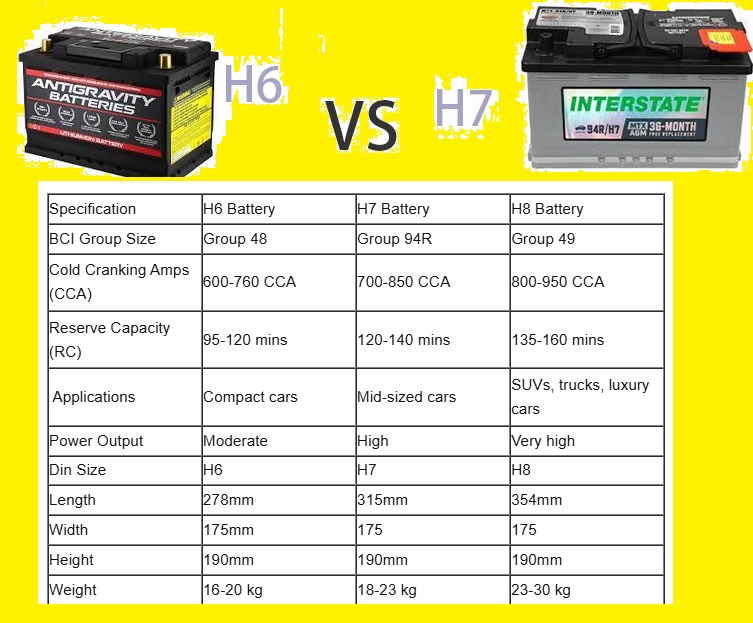
Here is a simple table showing basic specs for H6, H7, and H8 batteries:
| Battery Type | Approx. Size (inches) | Typical Capacity (Ah) | Cold Cranking Amps (CCA) |
|---|---|---|---|
| H6 | 7.5 x 6.9 x 7.5 | 60-70 | 600-700 |
| H7 | 7.7 x 7.1 x 7.5 | 70-80 | 700-800 |
| H8 | 8.3 x 7.5 x 7.5 | 80-100 | 800-900 |
Assess how often you drive and the climate. Cold areas need higher CCA batteries. Vehicles with many electronic devices may require batteries with greater capacity. Use Car Maintenance Tips to keep your battery in good shape and extend its life.
Budget And Preferences
Price is a big factor when choosing between H6, H7, and H8 batteries. Each type comes in different price ranges, affecting your budget. Consider these points:
- Budget Car Batteries: H6 batteries are usually cheaper but have lower capacity and lifespan.
- H7 and H8 batteries cost more but offer better Battery Lifespan Comparison and performance.
- Think about how often you want to replace the battery. Higher-priced batteries may save money over time.
- Check warranty and brand reputation. Good brands often provide longer warranties and better reliability.
Here is a quick price comparison table (prices may vary by region and brand):
| Battery Type | Average Price Range (USD) | Typical Lifespan (Years) |
|---|---|---|
| H6 | $70 – $100 | 3 – 4 |
| H7 | $90 – $130 | 4 – 5 |
| H8 | $110 – $150 | 5 – 6 |
Choose a battery that matches your budget but still meets your car’s needs. Think about how you use your car daily. Sometimes spending a bit more upfront means fewer problems later. Use Battery Performance Factors and Car Battery Types knowledge to make an informed choice.
Credit: www.theengineeringknowledge.com
FAQs For H6 Vs H7 Vs H8 Battery
What Are The Main Differences Between H6, H7, And H8 Batteries?
H6, H7, and H8 batteries differ in size, capacity, and application. H6 is compact, suited for small vehicles. H7 offers higher capacity for medium vehicles. H8 is largest, ideal for heavy-duty vehicles needing more power.
Which Battery Type Lasts Longest: H6, H7, Or H8?
H8 batteries generally last longest due to higher capacity and robust design. H7 offers moderate lifespan, while H6 lasts shortest because of smaller size and lower power reserve.
Are H6, H7, And H8 Batteries Interchangeable?
No, H6, H7, and H8 batteries are not interchangeable. Each fits specific vehicle requirements, sizes, and terminal layouts. Using the wrong type can cause poor performance or damage.
Which Battery Is Best For Cars: H6, H7, Or H8?
H6 is best for compact cars, H7 suits midsize cars, and H8 fits larger vehicles or trucks. Choosing depends on your car’s power needs and battery compartment size.
Conclusion
Choosing the right battery depends on your car’s needs and budget. H6 batteries suit small to medium vehicles well. H7 batteries offer more power for larger cars. H8 batteries provide extra strength for heavy-duty use. Each type has benefits that fit different situations.
Think about your driving style and weather conditions too. This helps you pick a battery that lasts longer and works better. Remember, a good battery keeps your car running smoothly every day.