What is the Legal Decibel Limit for Music: Ultimate Guide Revealed

Have you ever wondered how loud is too loud when it comes to music? Whether you’re at a concert, using headphones, or playing your favorite tunes at home, knowing the legal decibel limit for music is important for your hearing and safety.
If you’ve been curious about how loud music can get before it crosses the line, this article will give you clear answers. Keep reading to discover what those limits are, why they matter to you, and how you can enjoy your music without risking damage.
Your ears will thank you!
Decibel Limits By Location
Understanding the legal decibel limits for music is vital for everyone who plays or controls music volume. Different locations have unique rules called legal noise thresholds to protect people from loud sounds. These noise regulations vary by place, affecting how loud music can be. Knowing the decibel limits by location helps prevent complaints and avoids breaking the law. Below, we explore the typical limits in residential areas, commercial zones, and public events.
Residential Areas
Residential noise restrictions are usually the strictest to keep peace and quiet at home. These areas often have sound level ordinances that limit music volume, especially at night. The goal is to reduce noise pollution and protect residents’ comfort.
Common rules include:
- Maximum music volume usually between 40-55 decibels during the day.
- Lower limits at night, often 30-45 decibels, to avoid disturbance.
- Restrictions on the time when loud music is allowed, such as no loud sounds after 10 PM.
Here is an example of typical residential decibel limits:
| Time | Permissible Sound Level (dB) |
|---|---|
| Daytime (7 AM – 10 PM) | 50 dB |
| Nighttime (10 PM – 7 AM) | 40 dB |
Violating these residential noise restrictions may result in fines or warnings. Neighbors can file complaints if music volume exceeds the legal noise thresholds. Using music volume control tools helps stay within these limits and maintain good relations.
Commercial Zones
Commercial noise guidelines allow higher sound levels since businesses often use music to attract customers. Shops, restaurants, and bars must follow noise pollution laws but with more flexibility than residential areas.
Key points for commercial zones:
- Typical limits range from 55 to 70 decibels during business hours.
- Some zones may have no limits during special business events.
- Local governments enforce sound level ordinances to balance business needs and community peace.
Below is an example of common commercial decibel limits:
| Time | Permissible Sound Level (dB) |
|---|---|
| Business Hours (8 AM – 9 PM) | 65 dB |
| After Hours (9 PM – 8 AM) | 55 dB |
Businesses should use music volume control to avoid exceeding these limits. Ignoring commercial noise guidelines can lead to penalties and complaints from neighbors or local authorities.
Public Events
Public event sound limits differ greatly due to the nature of large gatherings like concerts or festivals. These events often require special permits that define the permissible sound levels. The limits aim to protect the public and nearby residents from excessive noise.
Important aspects of public event noise rules:
- Sound levels can reach up to 85-100 decibels depending on event size and location.
- Permit holders must follow specific noise regulations and may need to monitor sound levels during the event.
- Events held near residential areas usually face stricter limits.
Here is a typical range for public event sound limits:
| Event Type | Max Sound Level (dB) |
|---|---|
| Outdoor Concert | 95 dB |
| Indoor Event | 85 dB |
| Community Festival | 90 dB |
Organizers must respect these public event sound limits to comply with noise pollution laws. Proper sound checks and volume adjustments ensure safe and legal music levels.

Credit: www.ppsthane.com
Regulations For Music Venues
Understanding the legal decibel limit for music is essential for both venue owners and event organizers. Regulations for music venues vary widely but aim to control noise levels to protect public health and reduce noise pollution. These rules often include music volume laws, decibel restrictions, and concert noise ordinances. Meeting venue sound compliance ensures events are safe and enjoyable without disturbing neighbors or violating noise regulations. Different rules apply depending on whether a venue is indoors or outdoors. Sound level limits and occupational noise limits also help protect workers and attendees from hearing damage. Below, we explore these rules for indoor venues and outdoor venues.
Indoor Venues
Indoor venues usually have stricter audio decibel thresholds due to confined spaces. Sound can build up quickly, increasing the risk of hearing damage and noise complaints. Noise pollution guidelines for indoor venues often set limits between 85 and 95 decibels (dB) depending on local laws. These limits help balance good sound quality with safety.
Key points about indoor venue sound level limits:
- Maximum decibel level: Commonly capped at 90 dB for concerts and events.
- Time restrictions: Noise levels may be allowed to rise only during certain hours.
- Hearing protection standards: Venues must provide earplugs or warnings to protect listeners.
- Regular monitoring: Sound levels often require continuous checks to maintain compliance.
The table below shows typical indoor decibel restrictions in some regions:
| Region | Maximum Indoor Decibel Level | Notes |
|---|---|---|
| United States | 90 dB | Average over 15 minutes, OSHA guidelines apply |
| United Kingdom | 85 dB | Under Control of Noise at Work Regulations |
| Australia | 90 dB | Occupational Noise Limits, varies by state |
Maintaining these levels indoors prevents health risks and ensures venue sound compliance. It also reduces complaints from neighbors or nearby businesses.
Outdoor Venues
Outdoor venues face different challenges. Sound spreads more freely, but noise regulations often set lower limits to protect communities. Concert noise ordinances focus on reducing disturbance to nearby homes. Typical limits range from 70 to 85 dB, depending on location and time of day.
Important aspects of outdoor venue decibel restrictions include:
- Distance-based limits: Sound levels must decrease with distance from the stage.
- Curfews: Noise is often restricted after certain hours, such as 10 PM.
- Permits and approvals: Many areas require special permits with noise conditions.
- Noise monitoring: Real-time measurements ensure sound level limits are not exceeded.
The following table summarizes common outdoor music volume laws in various countries:
| Country | Maximum Outdoor Decibel Level | Restrictions |
|---|---|---|
| Germany | 80 dB | Measured at property line, strict curfews |
| Canada | 75 dB | Varies by province, often lower at night |
| Japan | 70 dB | Local ordinances with strict enforcement |
Outdoor venues must balance loud music with community peace. Following noise pollution guidelines and hearing protection standards keeps events safe and legal. Organizers should always check local rules for occupational noise limits and concert noise ordinances.
Enforcement Agencies
Enforcement agencies play a vital role in managing the legal decibel limit for music. They ensure compliance with decibel restrictions and legal noise thresholds set by law. These agencies monitor and control noise levels to protect public health and peace. Their work involves enforcing noise pollution laws and maintaining environmental noise standards. They also educate the public on music volume control and sound level limits. Understanding who these agencies are helps clarify how noise regulations are applied and what steps are taken when violations occur.
Local Authorities
Local authorities are the primary enforcers of local noise ordinances and permissible sound levels. They include city or town councils, police departments, and municipal offices that respond to noise complaints. Their duties often involve:
- Monitoring noise levels in neighborhoods and public areas
- Issuing warnings or fines for violations of sound level limits
- Providing guidelines on music volume control at events and venues
- Collaborating with other agencies to ensure compliance with noise pollution laws
Local authorities use tools like sound meters to measure noise. They follow specific rules about environmental noise standards that vary by location. For example, nighttime noise limits may be stricter than daytime. Here is a simple table showing typical local limits for music volume:
| Time of Day | Maximum Decibel Level (dB) | Notes |
|---|---|---|
| Daytime (7 AM – 10 PM) | 55 – 65 dB | Depends on zoning and area type |
| Nighttime (10 PM – 7 AM) | 45 – 55 dB | Stricter limits to reduce disturbance |
Local authorities enforce these limits strictly to maintain peace. They respond quickly to noise complaints about loud music or parties.
Noise Control Departments
Noise control departments specialize in managing noise issues within communities. They focus on enforcing noise regulations related to sound level limits and legal noise thresholds. Their main roles include:
- Conducting regular noise level inspections at public venues and residential areas
- Issuing permits for events that may exceed normal decibel restrictions
- Developing policies to reduce noise pollution in urban and rural settings
- Educating residents and businesses about music volume control and noise pollution laws
These departments often work closely with local authorities and other noise enforcement agencies. They ensure that all environmental noise standards meet state and federal guidelines. Here are key services offered by noise control departments:
- Noise monitoring and measurement
- Complaint investigation and resolution
- Community outreach and noise awareness campaigns
- Technical support for noise mitigation
By enforcing legal noise thresholds, noise control departments protect public health. They balance the enjoyment of music with the need for quiet, safe environments.
Credit: www.osha.gov
Penalties For Exceeding Limits
Understanding the penalties for exceeding the legal decibel limit for music is crucial for venues, event organizers, and individuals. Sound level limits exist to protect public health and reduce noise pollution. Violating these noise control laws can lead to serious consequences. Authorities enforce audio noise ordinances to maintain volume compliance standards and ensure the decibel threshold is respected. The most common penalties involve monetary fines and, in some cases, license revocation. These measures deter excessive noise and promote respect for community peace.
Fines
Noise pollution fines are the most immediate penalty for surpassing music volume restrictions. These fines vary depending on the severity of the violation and local noise regulations. Fines serve as a financial warning to control sound levels and encourage compliance with legal sound limits.
Fines typically depend on factors such as:
- How much the sound exceeded the decibel threshold
- Frequency of violations
- Time of day the violation occurred
- Type of location (residential, commercial, or public space)
For example, a venue repeatedly ignoring audio noise ordinances may face escalating fines. Below is a sample table illustrating possible fine ranges for exceeding sound limits:
| Violation Level (dB over limit) | First Offense Fine | Repeated Offense Fine |
|---|---|---|
| 1-5 dB | $100 – $300 | $300 – $600 |
| 6-10 dB | $300 – $700 | $700 – $1,500 |
| Over 10 dB | $700 – $2,000 | $2,000 – $5,000 |
These music license penalties encourage adherence to volume compliance standards. Paying fines does not guarantee future leniency. Repeated violations can lead to harsher punishments.
License Revocation
License revocation is a serious consequence for failing to meet sound level limits. This penalty applies mainly to businesses and venues holding permits for playing music. Authorities may revoke or suspend music licenses after repeated breaches of audio noise ordinances.
Revoking a license means a venue cannot legally play music or host events with amplified sound. This action enforces noise control laws strictly and protects local communities from ongoing disturbances.
Key reasons for license revocation include:
- Multiple violations of legal sound limits within a short period
- Ignoring warnings and prior fines
- Failure to implement noise reduction measures
- Complaints from residents or local authorities
Revocation impacts businesses significantly. It can lead to loss of customers and revenue. Some regions allow license reinstatement after improvements and compliance with music volume restrictions. Venues may need to:
- Install soundproofing
- Limit sound output
- Conduct regular noise level checks
- Train staff on noise regulations
Authorities aim to balance enjoyment of music with public peace. Noise pollution fines and license revocation form a legal framework that supports this balance. Respecting decibel thresholds helps avoid these penalties and promotes a safer sound environment.
Equipment And Measurement
Understanding the legal decibel limit for music requires knowing about the equipment and measurement used to monitor sound levels. Accurate sound monitoring ensures music volume stays within safe and legal boundaries. Authorities use precise tools and methods to measure noise, protecting people from hearing damage and reducing noise pollution.
Sound Level Meters
Sound Level Meters are essential tools in measuring noise. They detect sound pressure and convert it into decibel (dB) readings. These devices follow strict decibel regulations to ensure accurate results. Different types of sound level meters serve various purposes:
- Type 1 meters: High precision, used for official noise assessments.
- Type 2 meters: Less precise, used for general sound monitoring.
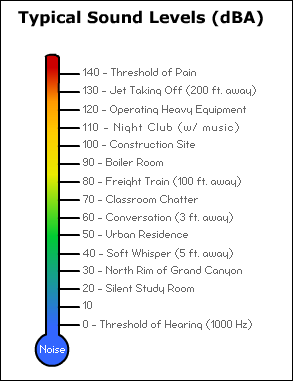
Sound level meters use the decibel scale, which measures how loud sound is. The scale is logarithmic, so every increase of 10 dB means the sound is 10 times stronger. For example, 70 dB is ten times louder than 60 dB.
| Sound Level Meter Type | Use Case | Accuracy |
|---|---|---|
| Type 1 | Legal noise limits, occupational noise standards | ±1.5 dB |
| Type 2 | General sound monitoring | ±2.5 dB |
Music volume restrictions often depend on readings from these meters. They help enforce noise pollution laws and maintain permissible noise levels in public and private spaces.
Measurement Procedures
Noise measurement procedures ensure that sound levels are recorded fairly and consistently. These steps follow official guidelines and support enforcement of legal noise limits and decibel regulations. A typical procedure includes:
- Calibrating the sound level meter before use.
- Selecting the correct weighting scale, usually A-weighting (dBA), to mimic human hearing.
- Positioning the meter at ear level or a specified distance from the sound source.
- Measuring sound over a set time, often 1 to 15 minutes.
- Recording peak and average noise levels.
During sound monitoring, background noise must be noted. It helps separate music noise from other sounds. Measurement locations vary by law, covering places like:
- Residential areas
- Workplaces under occupational noise standards
- Public events with music
Following these procedures protects hearing and enforces music volume restrictions. Proper measurement also supports legal action if noise limits are broken.

Credit: www.hollywoodfl.org
Variations By Country
Legal decibel limits for music vary widely by country due to different noise control policies and cultural attitudes. Each government sets its own permissible noise levels to protect public health and reduce noise pollution. These limits apply to concerts, clubs, and public events. Understanding these differences helps musicians, event organizers, and listeners stay within safe sound levels. Below is a look at key regions and their audio decibel thresholds.
United States
The United States uses Environmental Noise Guidelines set mainly by the Environmental Protection Agency (EPA) and local authorities. The legal noise limits differ by state and city, but common standards exist for music venues and public events.
Typical U.S. regulations include:
- Maximum 85 decibels (dB) for concerts lasting more than 8 hours.
- Short-term events can reach up to 100 dB but usually have time restrictions.
- Local laws often enforce stricter limits at night to reduce disturbance.
- Hearing protection standards recommend using earplugs at 85 dB or higher.
Many cities enforce noise pollution laws through fines and event permits. Venues must monitor sound levels using decibel meters to comply with music volume restrictions. Below is a table showing common U.S. sound limits:
| Setting | Maximum Decibel Level | Time Limit |
|---|---|---|
| Outdoor Concerts | 100 dB | 2 hours |
| Indoor Clubs | 90 dB | No specific limit |
| Residential Areas (Night) | 55 dB | 10 pm – 7 am |
European Union
The European Union enforces sound level limits through directives aimed at protecting hearing and controlling noise pollution. These laws focus on noise control policies for workplaces, public spaces, and entertainment venues.
Key points about EU regulations:
- The maximum allowed music volume usually ranges between 90 dB and 100 dB for public events.
- Workplace hearing protection standards require action if noise exceeds 85 dB over 8 hours.
- Many countries follow the EU Environmental Noise Directive, which sets limits for residential and mixed zones.
- Some countries impose strict limits on amplified music in public transport and nightlife areas.
The EU encourages the use of sound limiters and regular noise monitoring. The following table summarizes common decibel regulations in select EU countries:
| Country | Max Music Level | Notes |
|---|---|---|
| Germany | 100 dB | Time restrictions apply |
| France | 102 dB | Mandatory sound limiters |
| Sweden | 90 dB | Strict residential limits |
Other Regions
Many countries outside the U.S. and EU have unique decibel regulations based on local needs. These legal noise limits aim to balance entertainment with community well-being.
Examples include:
- Australia: Music volume restrictions set around 90 dB for public events, with noise control policies varying by state.
- Japan: Strict environmental noise guidelines limit outdoor music to 85 dB near residential areas.
- Brazil: Noise pollution laws limit music to 70 dB in many urban zones to reduce hearing damage.
Many regions lack uniform standards, so organizers must check local laws before events. Portable sound level meters help maintain compliance. Below is a quick summary:
| Region | Typical Limit | Additional Rules |
|---|---|---|
| Australia | 90 dB | Varies by state |
| Japan | 85 dB | Residential restrictions |
| Brazil | 70 dB | Urban zone limits |
Impact On Musicians And Venues
The impact of legal decibel limits on musicians and venues is significant. These limits shape how music is played and heard. Venues must balance creating a lively atmosphere with following noise compliance guidelines. Musicians face challenges adjusting their sound to meet legal sound thresholds. Understanding these effects is key for both groups to avoid penalties and protect their audience and themselves.
Compliance Challenges
Following music volume laws can be difficult for musicians and venues. Many places have strict decibel restrictions to control noise pollution. These limits often range between 85 to 100 decibels, depending on local noise regulations. Venues must measure sound levels during events to meet these limits. Failure to comply can result in fines or closure.
Common compliance challenges include:
- Unreliable sound measuring equipment
- Changing crowd size affecting sound levels
- Outdoor venues facing less predictable sound spread
- Musicians needing to adjust volume on the fly
- Limited space for soundproofing or acoustic treatment
Venues often use sound engineers to monitor levels in real-time. Some install permanent noise monitoring systems that alert staff when approaching legal sound thresholds. Musicians may have to use in-ear monitors or lower amplifier settings to comply. A clear understanding of noise compliance guidelines helps prevent fines and keeps shows running smoothly.
| Challenge | Impact | Solution |
|---|---|---|
| Unpredictable sound levels | Difficulty maintaining compliance | Use real-time monitoring and adjust volume |
| Venue size and acoustics | Sound may exceed limits in certain areas | Install soundproofing and acoustic panels |
| Equipment variability | Inconsistent sound output | Regular calibration and maintenance |
Health And Safety Considerations
Protecting hearing is a top concern under occupational noise exposure rules. High volumes can cause permanent hearing loss. Musicians and venue staff face auditory health risks without proper care. Hearing protection standards guide safe exposure times and sound limits.
Key health and safety considerations include:
- Limiting sound exposure to recommended sound level limits
- Providing earplugs or other hearing protection
- Scheduling breaks to reduce continuous noise exposure
- Educating staff and performers about risks
- Monitoring noise levels to stay within legal sound thresholds
Venues must follow noise pollution control rules to protect everyone’s hearing. Musicians should use custom earplugs that reduce volume without hurting sound quality. Regular hearing tests help detect early signs of damage. These practices align with noise regulations designed to prevent hearing loss and promote safe environments.
| Health Risk | Safe Exposure Limit | Protection Method |
|---|---|---|
| Temporary hearing loss | Up to 85 dB for 8 hours | Use earplugs and limit exposure time |
| Permanent hearing damage | Above 85 dB for extended periods | Monitor sound levels and take breaks |
| Tinnitus (ringing ears) | Exposure to sudden loud sounds | Wear noise-canceling ear protection |
Frequently Asked Questions
What Is The Legal Decibel Limit For Music In Public Places?
The legal decibel limit varies by location but usually ranges from 55 to 85 dB. Local laws set these limits to prevent noise pollution and protect hearing. Always check regional regulations before playing music in public spaces.
How Long Can You Play Music At The Legal Decibel Limit?
Duration limits depend on the decibel level; higher volumes require shorter exposure times. For example, 85 dB is safe for up to 8 hours, while 100 dB should be limited to 15 minutes. Follow guidelines to avoid hearing damage.
Are There Different Decibel Limits For Indoor And Outdoor Music?
Yes, outdoor music often has higher decibel limits due to open spaces. Indoor limits tend to be lower to reduce noise disturbance. Both settings require compliance with local noise ordinances for public safety and comfort.
Can I Be Fined For Exceeding Legal Music Decibel Limits?
Yes, exceeding legal decibel limits can result in fines or penalties. Authorities enforce these rules to control noise pollution and protect public health. Always monitor volume levels to stay within legal limits.
Conclusion
Knowing the legal decibel limit helps protect your hearing and obey the law. Most places set limits around 85 to 100 decibels for music. Keeping sound below these levels avoids fines and noise complaints. It also keeps events safe and enjoyable for everyone.
Always check local rules before playing loud music. Staying within limits shows respect for neighbors and the community. Sound can be fun without causing harm or trouble. Remember, safe listening is smart listening.