

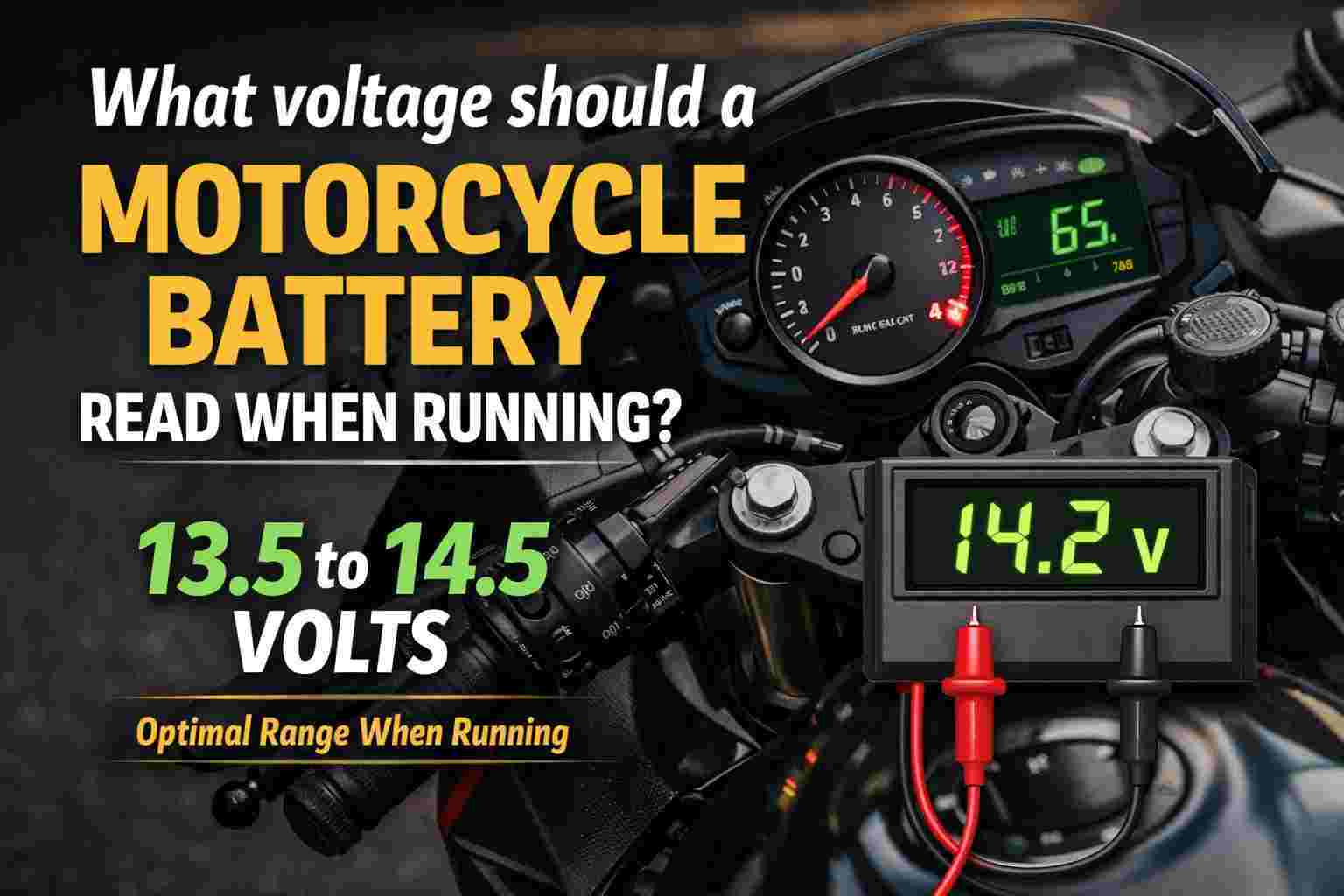
When your motorcycle is running, the battery is no longer on its own.
The charging system takes over. Here’s the simple version:
- The stator makes electricity
- The regulator/rectifier controls it
- The battery stores it and smooths it out
If all three are healthy, voltage stays in a safe range. That range tells you a lot.
The Critical Voltage Range: 13.5–14.5 Volts Explained
For most motorcycles, a healthy charging system will show:
13.5 to 14.5 volts while running
This range exists for a reason.
- Below 13.5V, the battery may not charge
- Above 14.5V, the battery can be damaged
- Inside this window, charging is safe and steady
Think of it like filling a cup.
Too slow and it never fills.
Too fast and it spills everywhere.
The regulator’s job is to keep the flow just right.
Inside the battery, this voltage pushes energy back into the plates at a safe rate.
Not aggressive.
Not weak.
That’s why this range matters.
What Your Specific Reading Means
Here’s a quick breakdown of the most common readings riders see.
13.5–14.0 volts
This is ideal.
Your charging system is working normally.
14.0–14.5 volts
This is the high end of normal.
Often seen when revving the engine.
Safe if it stays stable.
12.8–13.4 volts
This is the gray zone.
Not an emergency, but not something to ignore.
It needs follow-up testing.
14.6 volts or higher
This is a red flag.
Overcharging can destroy batteries and electronics fast.
If your voltage changes with RPM, don’t panic yet.
That’s normal — to a point.
How to Properly Test Your Motorcycle Battery Voltage While Running
Many charging problems are misdiagnosed because of bad testing.
The bike isn’t broken.
The test is.
Here’s how to do it the right way.
Equipment You Need (And Common Mistakes)
You only need:
- A basic digital multimeter
- Fresh meter batteries
Set the meter to:
- DC volts
- 20V range (or auto-ranging)
Avoid these common mistakes:
- Testing on the frame instead of the battery
- Loose probe contact
- Cheap meters that jump around
Always place probes directly on the battery terminals.
That gives the most accurate reading.
Step-by-Step Testing Protocol
This is the exact process I use.
Step 1: Static Test (Engine Off)
With the engine off, check voltage.
A healthy battery usually shows:
- 12.6–12.8 volts
If you see below 12.4V, charge the battery first.
Diagnosing a charging system with a weak battery leads to bad conclusions.
Step 2: Idle Test (Engine Running)
Start the bike and let it idle.
Normal readings:
- 13.0–13.5 volts
Many bikes don’t charge strongly at idle.
This is especially true for older motorcycles.
Step 3: Rev Test (2,000–3,000 RPM)
Gently raise engine speed.
You should see:
- Voltage rise
- Then stabilize between 13.5–14.5V
This shows the stator is producing power and the regulator is controlling it.
Step 4: Load Test
Turn on electrical loads:
- Headlight
- Heated grips
- Accessories
Healthy systems may dip slightly, then recover.
If voltage collapses, that’s a clue.
Variables That Affect Voltage Readings
Voltage is not a fixed number.
It changes based on:
- Temperature
- Battery state of charge
- Engine RPM
- Time since last ride
Cold weather lowers readings.
Hot weather raises them.
Testing immediately after riding often shows higher numbers than testing cold.
Both can be useful if you understand the difference.
Diagnosing Problems Based on Voltage Readings
Now the numbers start to mean something.
Low Voltage While Running (Under 13.5V)
This is common and often misunderstood.
First question:
Does voltage rise at all when you rev the engine?
- If yes, the system may still be working
- If no, further testing is needed
Before blaming major parts, always check:
- Battery terminals
- Grounds
- Regulator connectors
- Corrosion
Many “charging failures” are just bad connections.
High Voltage While Running (Over 14.8V)
This is serious.
Overcharging:
- Boils lead-acid batteries
- Swells AGM batteries
- Trips lithium battery protection
- Burns out bulbs and electronics
If voltage keeps climbing with RPM, the regulator is usually failing.
Fixing it early is cheap.
Ignoring it is not.
Fluctuating Voltage Readings
Intermittent problems are the hardest.
Common causes include:
- Loose grounds
- Heat-related stator failures
- Overheating regulators
These often test fine when cold and fail when hot.
The Voltage–RPM Relationship
Some voltage change with RPM is normal.
At Idle (900–1,200 RPM)
Many bikes show:
- 13.0–13.5V
This is usually fine, especially on older motorcycles.
At Cruising RPM (3,000–5,000 RPM)
This is where charging should be strongest.
Healthy systems:
- Stabilize voltage
- Hold 13.8–14.5V
- Stay steady under load
At High RPM (6,000+ RPM)
Voltage should not keep rising.
If it does, regulation is failing.
Battery Type Matters
Different batteries want different charging behavior.
Lead-Acid Batteries
Preferred range:
- 14.0–14.4V
Many older bikes run slightly lower, which is fine.
AGM Batteries
Preferred range:
- 14.2–14.8V
Some bikes charge too low for AGM, shortening battery life.
Lithium (LiFePO4) Batteries
Preferred range:
- 13.6–14.6V
They dislike overcharging and weak idle charging.
System compatibility matters.
When to Worry: Red Flags Beyond Voltage
Pay attention if you notice:
- Dimming lights that don’t recover
- Battery getting hot
- Hard starting when warm
- Accessories cutting out
- Frequent bulb failure
Voltage numbers don’t tell the whole story.
Patterns do.
Quick Voltage Diagnostic Decision Tree
13.5–14.5V while running
✓ System healthy
✓ Normal riding
12.8–13.4V while running
⚠ Undercharging
Check battery, grounds, and connectors soon
14.6V+ while running
🚨 Overcharging
Stop long rides and inspect regulator immediately
DIY vs. Professional Testing
What You Can Do at Home
- Voltage testing
- Visual inspection
- Basic continuity checks
What Often Needs a Shop
- Heat-related stator testing
- Dynamic load tests
- Intermittent failures
A multimeter saves money.
Guessing costs more.
Preventive Maintenance Tips
Monthly
- Quick voltage check
- Inspect terminals
Seasonally
- Clean connections
- Apply dielectric grease
- Check stator cover for oil leaks
Oil slowly destroys stators.
Battery Tender Best Practices
Between rides, maintenance charging helps.
Ideal maintenance voltage:
- 13.6–13.8V
This alone can double battery life.
Frequently Asked Questions (FAQ)
What voltage should a motorcycle battery read when running?
Most motorcycles should read 13.5–14.5 volts at cruising RPM.
Is 13.2 volts normal while running?
At idle, yes.
At 2,500–3,000 RPM, no.
Is 14.8 volts too high?
Yes.
Anything above 14.6–14.8V indicates overcharging.
Why does voltage change when I rev the engine?
Because stator output increases with RPM.
Voltage should rise, then stabilize.
Should I test on the frame or battery?
Always test directly on the battery terminals.
Does battery type affect voltage?
Yes. Lead-acid, AGM, and lithium batteries all prefer slightly different ranges.
How often should I check voltage?
Once a month, before long trips, and after adding accessories.
Final Thoughts
A motorcycle battery should read about 13.5–14.5 volts when running at cruising RPM.
But the number alone doesn’t diagnose problems.
Test correctly.
Watch patterns.
Fix small issues early.
That’s how you keep riding — instead of troubleshooting on the side of the road.