The Ultimate Harley Air Shock Pressure Chart Guide 2025

Getting the right air shock pressure is key to a smooth and safe ride on your Harley. If you’ve ever felt your bike’s ride change, you might have been dealing with the wrong pressure in your shocks. Too high or too low, and the bike won’t feel right.
Air suspension is designed to give you comfort. But only if it’s set properly. It adjusts how soft or firm your ride is. Think of it like adjusting the suspension for different road types. You want to make sure it works for your weight and how you ride. This is where the air shock pressure chart comes in.
The chart is your guide to adjust the air shock pressure for different situations. Whether you’re riding solo or with a passenger, or even when you’ve got a lot of gear, the right pressure keeps the ride comfortable and helps your Harley perform at its best.
What Is Harley Air Suspension?
Harley-Davidson’s air suspension uses flexible “air springs” to make your ride smoother. These air springs are inflated by a pump, either electric or manual. The air pressure inside the spring controls how firm or soft your ride feels.
With more pressure, the ride is firmer. Lower pressure gives you a softer ride. It’s that simple. But getting the right balance is the key. Too much air pressure can make the ride feel stiff and bumpy. Too little can cause your bike to bottom out, which could damage the shocks.
It’s not just about comfort. The right air shock pressure also affects how your bike handles. It impacts everything from how the bike corners to how it absorbs bumps in the road.
Why Getting It Right Is So Important
Having the right pressure isn’t just about feeling comfortable. It’s about how your bike handles, how it feels on the road, and how safe it is to ride. If your air shocks aren’t set properly, it can lead to harsh rides, poor handling, and even damage to the suspension system.
When you get the pressure right, your Harley handles better, absorbs road shocks better, and feels more stable. It also helps prevent problems like bottoming out or swaying during cornering. Your bike will also last longer with the right pressure, as improper settings can lead to more wear and tear.
Now, let’s look at how the Harley air shock pressure chart can help you adjust the pressure for your specific riding needs.
More Read: Harley Davidson Handlebar Size Chart
Understanding the Harley Air Shock Pressure Chart
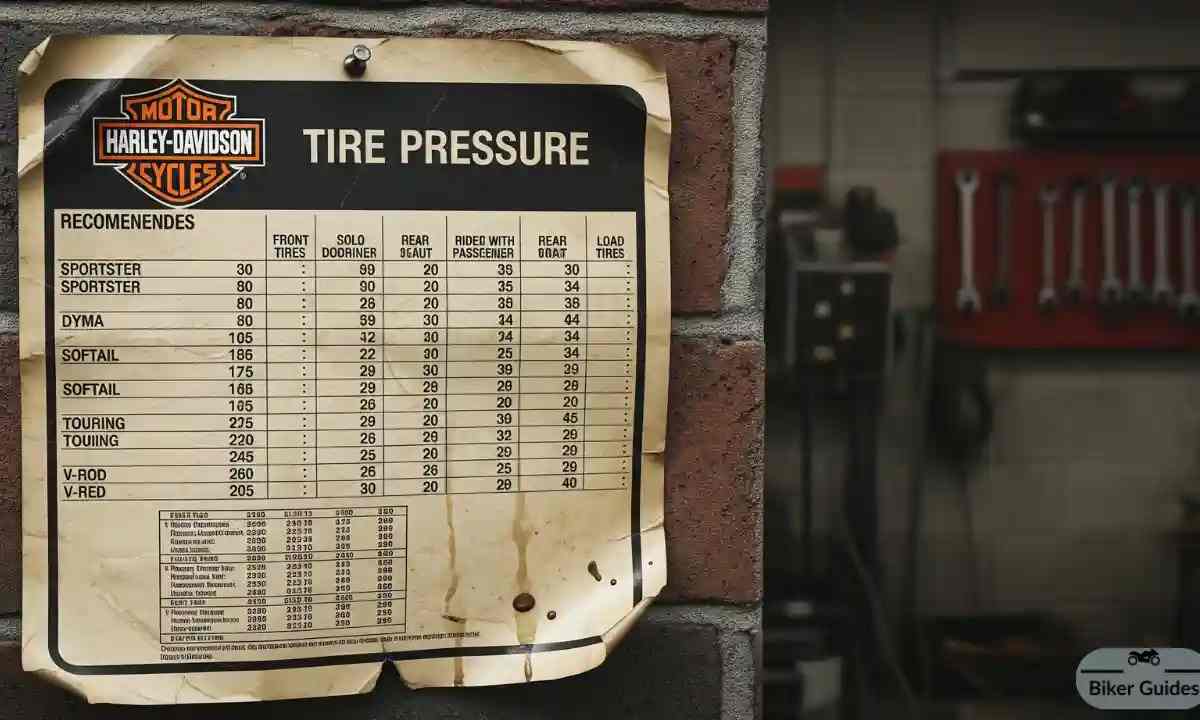
Now that we know why air shock pressure is so important, let’s dive into how to use the Harley air shock pressure chart. The chart offers recommended starting points for different situations, depending on your bike model, load, and riding conditions.
Each Harley model has its own chart, but generally, the pressures are set based on your weight and the weight you’re carrying. Solo riders, riders with passengers, or those carrying heavy loads will all need different pressure settings. Let’s break down how to adjust the air shock pressure for common situations.
Solo Riding
If you’re riding alone, the pressure depends on your weight. For example, if you weigh around 150 lbs, you might need a pressure of around 10 PSI. This is ideal for solo riders who don’t have a passenger or a lot of gear. For those on the heavier side, like 250 lbs or more, you’ll want to go higher, around 20 to 25 PSI, to prevent bottoming out when hitting bumps.
A good rule of thumb: the heavier you are, the more pressure you’ll need. The chart is a guide, but personal preference and comfort play a role too.
Riding with a Passenger
When you’re riding with a passenger, you’ll need to increase the air shock pressure to handle the added weight. For example, with a passenger and luggage, pressures can go up to 40 or 50 PSI. If you’re riding with a lighter passenger, somewhere between 30-40 PSI should do the trick.
Remember, the added weight changes how your bike handles. You’ll notice the difference in how the bike absorbs bumps or how it handles turns. Too little air pressure, and the bike might feel sluggish or bouncy. Too much, and it can feel too stiff and uncomfortable.
Touring or Heavily Loaded Rides
When you’re touring or riding with heavy luggage, you’ll need the most air pressure. For long trips, you’ll likely be carrying more gear. For instance, solo riders carrying a heavy load (over 250 lbs) may need 35-50 PSI. That’s because the bike needs extra support to handle the extra weight without bottoming out.
It’s not just the load on your back that matters but also how your bike reacts to it. Touring setups with more weight often feel better with a firmer suspension, so you’re less likely to bottom out on rough roads.
Why You Should Experiment with Pressure Settings
Everyone’s ride is different. The chart gives you a starting point, but the best way to find what works for you is to experiment with small adjustments. Start with the recommended pressure based on your weight and add or release air as needed.
Take a test ride after every adjustment to see how it feels. Even a slight change, like 2 PSI, can make a difference in ride quality. You’ll know when you hit that sweet spot because the bike will feel more stable, absorb bumps better, and corner with ease.
More Read : Harley Davidson Oil Capacity Chart
Adjusting Your Harley’s Air Shock Pressure: A Step-by-Step Guide
Now that we have a basic understanding of the pressure chart, let’s get into the nuts and bolts of how to adjust your Harley’s air shock pressure. Properly adjusting your air shocks is crucial to ensure a smooth, comfortable ride, especially when you’re dealing with different weights and riding conditions.
Step 1: Gather Your Tools
Before you start, you’ll need a few things:
- Air Suspension Pump: Harley-Davidson offers a dedicated air suspension pump (Part Number: HD-34633), but you can also use aftermarket pumps. The key is to make sure the pump is accurate and easy to use.
- Pressure Gauge: A good pressure gauge will help you monitor the air pressure as you adjust it. Many pumps come with a built-in gauge, but if you’re using a separate one, make sure it’s calibrated correctly.
- Valve Cap Removal Tool: Some models require you to remove a cap before accessing the air valve, so it’s handy to have a small tool to remove that easily.
Step 2: Locate the Air Valve
The air valve for your Harley’s rear suspension is typically located on the left side of the bike, just below the frame cover. If you’re unsure, check your bike’s manual for exact instructions. On many touring models, you’ll need to open the left saddlebag lid to access it.
Step 3: Check the Current Pressure
Once you’ve located the air valve, it’s time to check the existing pressure. Use your air suspension pump or a separate gauge to see what the current pressure is. This will give you a baseline before making any adjustments.
Step 4: Adjust the Pressure
To adjust the air pressure, follow these steps:
- To Increase Pressure: Attach the pump to the air valve. If you need to increase the pressure, just pump air into the suspension system. Be sure to do this slowly and in small increments.
- To Decrease Pressure: If you need to lower the pressure, press the valve release button gently. Releasing too much air too quickly can lead to uneven adjustments, so go slow.
Step 5: Test Ride and Recheck
Once you’ve adjusted the pressure, take the bike for a short test ride. This allows you to feel how the bike responds and check if the new pressure settings are working well for you. If it feels too stiff or too soft, make small adjustments until you find that sweet spot.
Remember, it’s all about balance. You don’t want to over-inflate or under-inflate the shocks. Keep the air pressure within the recommended range, but feel free to tweak it for your personal comfort.
Recommended Air Pressure for Harley-Davidson Touring Models (Without Tour-Pak)
This table provides comprehensive OEM guidelines for solo riding, solo riding with luggage, and two-up riding on standard touring models that do not have the additional weight and altered dynamics of a Tour-Pak. It serves as a primary reference for a large segment of Harley owners, ensuring a safe and comfortable baseline for frequent riding configurations.
| SHOCK LOAD | TOTAL WEIGHT (kg / lb) | PRESSURE (PSI) | PRESSURE (kPa) |
| Solo rider | up to 68 kg (150 lb) | 0 | 0 |
| Solo rider | 68–91 kg (150–200 lb) | 0-10 | 0-69 |
| Solo rider | 91–113 kg (200–250 lb) | 10-20 | 69-138 |
| Solo rider | 113–136 kg (250–300 lb) | 20-30 | 138-206 |
| Solo rider | 136 kg (300 lb) to max added weight* | 30-50 | 206-345 |
| Solo rider with 18 kg (40 lb) luggage | up to 68 kg (150 lb) | 10-20 | 69-138 |
| Solo rider with 18 kg (40 lb) luggage | 68–91 kg (150–200 lb) | 20-30 | 138-206 |
| Solo rider with 18 kg (40 lb) luggage | 91–113 kg (200–250 lb) | 30-40 | 206-276 |
| Solo rider with 18 kg (40 lb) luggage | 113–136 kg (250–300 lb) | 40-50 | 276-345 |
| Solo rider with 18 kg (40 lb) luggage | 136 kg (300 lb) to max added weight* | 50 | 345 |
| Rider plus passenger | Any weight up to max added weight* | 40-50 | 276-345 |
| Maximum loaded vehicle | Maximum added weight* | 50 | 345 |
Note: If an optional Tour-Pak is installed, add 34–69 kPa (5–10 psi) to shock pressure, but do not exceed 345 kPa (50 psi) suspension pressure.
Recommended Air Pressure for Harley-Davidson Touring Models (With Tour-Pak)
This table is crucial for riders with factory-installed or aftermarket Tour-Paks, as the added weight and altered center of gravity significantly impact suspension requirements. It provides specific, higher pressure recommendations for these configurations, ensuring stability and preventing bottoming out under heavier loads.
| SHOCK LOAD | TOTAL WEIGHT (kg / lb) | PRESSURE (PSI) | PRESSURE (kPa) |
| Solo rider | up to 68 kg (150 lb) | 5-10 | 34-69 |
| Solo rider | 68–91 kg (150–200 lb) | 10-20 | 69-138 |
| Solo rider | 91–113 kg (200–250 lb) | 20-30 | 138-206 |
| Solo rider | 113–136 kg (250–300 lb) | 30-40 | 206-276 |
| Solo rider | 136 kg (300 lb) to max added weight* | 40-50 | 276-345 |
| Solo rider with 32 kg (70 lb) luggage | up to 68 kg (150 lb) | 25-30 | 172-206 |
| Solo rider with 32 kg (70 lb) luggage | 68–91 kg (150–200 lb) | 30-40 | 206-276 |
| Solo rider with 32 kg (70 lb) luggage | 91–113 kg (200–250 lb) | 40-50 | 276-345 |
| Solo rider with 32 kg (70 lb) luggage | 113 kg (250 lb) to max added weight* | 50 | 345 |
| Rider plus passenger | Any weight up to max added weight* | 50 | 345 |
| Maximum loaded vehicle | Maximum added weight* | 50 | 345 |
Note: Do not exceed 345 kPa (50 psi) suspension pressure.
Recommended Air Pressure for Harley-Davidson FLHX (Street Glide) Models
The FLHX (Street Glide) is an exceptionally popular Harley-Davidson model, often featuring a lower-profile rear suspension. This dedicated table provides specific guidelines tailored to its unique design, ensuring accurate pressure settings for this widely owned motorcycle and directly addressing a common user need.
| SHOCK LOAD | TOTAL WEIGHT (lbs / kg) | PRESSURE (PSI) | PRESSURE (kPa) |
| Solo Rider | up to 160 lbs (0-73 kg) | 0-5 | 0-35 |
| Solo Rider | 160-200 lbs (73-91 kg) | 0-10 | 0-69 |
| Solo Rider | Over 200 lbs (91 kg) | 5-10 | 35-69 |
| Rider with passenger | up to 150 lbs (0-68 kg) | 20-30 | 138-207 |
| Rider with passenger | over 150 lbs (over 68 kg) | 25-35 | 172-241 |
| Maximum GVWR | See Label | 40-50 | 276-345 |
Note: Do not exceed 50 psi (345 kPa) for FLHX models.
Recommended Air Pressure for Harley-Davidson 2006 Police Models
While specific to a particular year and model type, this table is critically important because it highlights a significantly lower maximum pressure (35 PSI) compared to the general 50 PSI limit found in other charts. This serves as a crucial safety warning and underscores the absolute necessity of consulting model-specific documentation to prevent over-inflation and potential damage. The maximum recommended OEM pressure for most Harley air shocks is 50 PSI (345 kPa), but some specific models have a lower maximum of 35 PSI. This discrepancy is a critical safety point. A rider might assume a universal 50 PSI limit, potentially over-inflating and damaging shocks on models with a lower limit. This emphasizes the absolute necessity for riders to consult their specific owner’s manual or the correct model-specific chart to avoid serious mechanical failure or safety hazards.
| SHOCK LOAD | TOTAL WEIGHT (kg / lb) | PRESSURE (kPa) | PRESSURE (PSI) |
| Solo rider | 0-68 kg (up to 150 lb) | 0 | 0 |
| Solo rider | 68-91 kg (150-200 lb) | 0-69 | 0-10 |
| Solo rider | 91-113 kg (200-250 lb) | 35-103 | 5-15 |
| Maximum GVWR | 544 kg (1200 lb) | 138-241 | 20-35 |
Note: For all but FLHX models, do not exceed 35 psi (241 kPa).
Common Issues and Troubleshooting Harley-Davidson Air Shocks
Even with regular maintenance and proper adjustments, there are times when your Harley’s air shocks might show signs of issues. The good news is that many of these problems are easy to spot and fix if you catch them early. Let’s dive into some common issues riders face and how you can troubleshoot them.
1. Harsh Ride
If your ride feels stiffer than usual and you’re feeling every bump on the road, it’s a sign that the air pressure may be too high. When the air pressure is too high, the suspension becomes too firm, and it won’t absorb bumps as well. To fix this, you’ll need to decrease the air pressure a little at a time.
2. Mushy Cornering with Sway
If your Harley feels unstable when you’re leaning into turns, you may have too little air pressure. When the suspension is too soft, it can cause the bike to sway and feel “mushy.” This can also happen if you’ve overloaded your bike. Try adding some air to the shocks and see if that improves the stability in turns.
3. Bottoming Out on Bumps
One of the most frustrating things that can happen is when your bike bottoms out—especially when you’re hitting rough bumps or potholes. This usually happens when there’s not enough air in the shocks. If the shocks bottom out, they won’t be able to absorb the impact properly, and the ride will be harsh. To fix this, add more air to the suspension.
4. Sagging Suspension
If your Harley is sitting lower than usual, even when you’re not riding, it could be a sign of an air leak. When the shocks are losing air, the suspension can sag, making the bike feel less responsive and potentially unsafe. If you notice this issue, the first thing to check is for air leaks in the system. Use soapy water on the connections to see if bubbles form, indicating a leak.
5. Longer Air-Up Cycles
If the air shocks are taking longer than usual to inflate, this could also be a sign of an air leak. Check the air lines and the compressor to make sure everything is sealed properly. If there’s a leak, you’ll need to identify the source and fix it before you can adjust the air pressure again.
6. Loss of Air Pressure Overnight
This is a big red flag. If you notice that your air shocks are losing significant pressure (5 lbs or more) overnight, it usually means there’s a major leak somewhere in the system. This isn’t a minor issue—it’s best to get it checked and fixed immediately.
7. Noticeable Change in Ride Quality
If the handling or comfort of your bike seems to have changed for the worse, it could be due to incorrect air pressure or a failing shock. Pay attention to how your bike feels during different riding conditions and adjust the air pressure accordingly.
Finding and Fixing Air Leaks
Air leaks are often the cause of many common shock issues. Here’s how you can find and fix them:
- Inspect the Air Lines: Air lines are flexible and vulnerable to cuts or punctures from road debris. Check for any visible damage to the lines and replace them if necessary.
- Examine the Seals and Gaskets: The rubber seals and gaskets in the air suspension can wear out over time. If these are cracked or corroded, they’ll need to be replaced.
- Test the Compressor: If you’re using an aftermarket air compressor, check the connections and make sure there’s no damage or warping. If it’s damaged, replacing it is usually easier than trying to repair it.
- Use Soapy Water: For a simple leak test, apply a mixture of soapy water to the connections, air springs, and lines. Any leaks will bubble up, showing you where to focus your repair efforts.
- Replacing Damaged Parts: Sometimes, replacing a component is the best option. If your air spring is punctured or too worn, it’s time to get a new one. Likewise, a damaged compressor should be replaced to ensure your air suspension works properly.
By regularly checking your suspension system and staying on top of any potential issues, you can avoid bigger problems down the road.
More Read: Twin Cam 88 Oil Capacity Chart
Frequently Asked Questions (FAQs)
1. What is the Harley-Davidson air shock pressure chart?
The Harley-Davidson air shock pressure chart shows the recommended air pressure for different riding conditions. It helps you adjust your bike’s suspension for comfort and handling based on your weight and load.
2. How do I adjust the air shock pressure on my Harley-Davidson?
To adjust your Harley air shocks, use an air pump to check and set the pressure. Start with the recommended PSI, and make small adjustments until you find your preferred ride comfort.
3. Why is it important to use the correct air shock pressure on a Harley-Davidson?
Using the correct air shock pressure ensures a smoother, safer ride. It improves comfort, prevents bottoming out, and helps maintain good handling, especially when carrying heavy loads or riding with a passenger.
4. What happens if the air shock pressure is too high or too low on my Harley?
If the pressure is too high, the ride will be stiff and harsh. If it’s too low, the shocks may bottom out on bumps, causing discomfort and potentially damaging the suspension.
5. How do I know if my Harley-Davidson’s air shocks need maintenance?
Signs that your air shocks need maintenance include a rough ride, air pressure loss overnight, or sagging suspension. These issues often mean there’s a leak or incorrect air pressure.
6. Can I use any air pump to adjust my Harley-Davidson’s shock pressure?
It’s best to use a Harley-approved air pump like the HD-34633. This ensures accurate pressure and prevents damage to the suspension. Avoid using high-pressure air compressors.
7. What is the recommended air pressure for a solo rider on a Harley-Davidson?
For solo riders, the recommended air pressure typically ranges from 0-20 PSI, depending on your weight. Heavier riders may need 20-30 PSI to prevent bottoming out and maintain ride quality.
8. How do I adjust the air shock pressure when I have a passenger on my Harley?
When riding with a passenger, increase the air pressure to 25-45 PSI, depending on the combined weight. This ensures proper suspension support and prevents sagging.
9. What is the maximum air pressure for Harley-Davidson air shocks?
Most Harley-Davidson models recommend a maximum air pressure of 50 PSI (345 kPa). However, some models, like the 2006 Police version, have a lower max of 35 PSI.
10. How do I find the “sweet spot” for my Harley air shock pressure?
Finding the “sweet spot” involves experimenting with small adjustments, typically 2 PSI at a time. Test your bike’s comfort and handling after each change to find the ideal setting for your ride.
Conclusion
Getting your Harley-Davidson’s air shock pressure right is a big part of how your bike feels and handles. It’s not just about following a chart; it’s about making the ride yours. The right air pressure can make your bike more comfortable and easier to handle. But the best setting depends on you—your weight, your riding style, and the load you carry.
Key Points
- Start with the Basics: Harley gives you great starting points with their air shock pressure charts. These numbers work well for most people, but don’t think they’re the final answer. You might need to make small changes to suit your ride.
- Experiment for Comfort: Finding your “sweet spot” takes time. Small changes—just a couple of PSI—can make a big difference. Try different settings and see what feels best.
- Look for Signs of Trouble: If your ride feels too rough or soft, or if your shocks bottom out on bumps, it’s time to adjust the pressure. Keeping an eye on these signs can help you catch problems early.
- Check for Leaks: Leaks can mess up your air shock pressure. Make it a habit to check the air lines and seals for cracks or damage. Fixing leaks early will keep your suspension in good shape.
- Regular Maintenance: Adjusting the pressure is just part of it. Make sure you check your shocks and air system regularly. This will help your bike perform better and last longer.
Finding the right air shock pressure is key to getting the most out of your Harley. Don’t be afraid to make small adjustments until you find what works best for you. The more you tweak, the better your ride will feel. Keep in mind that your comfort and safety are most important. So, take the time to adjust the suspension and enjoy the ride!