Motorcycle Oil vs Car Oil: My Honest Breakdown

Motorcycle oil and car oil are very different. This is not for ads. It is because their engines are built in very different ways. Both oils stop parts from rubbing and wearing out. But they work in very different places. This makes them special fluids. Each oil is made to fix its own set of problems. Bikes are made to be small and light. They have a lot of power. This puts special stress on the oil. Cars do not have this stress. We need to know how the engines are different. This is the first step. It helps us see why car oil can be bad for a bike.
You can also read : Can you use motorcycle oil in a car?-My Pithy Answer
One Oil for Three Jobs
The biggest difference is how the oil is shared. Most cars have separate parts. The engine has its own oil. The transmission has its own fluid.
Most bikes are different. The engine, gears, and clutch all share one oil. This is called a “common sump” system. This design makes the bike small and light. But it is very hard on the oil. The oil must do three jobs at once:
- Help the Engine: It keeps engine parts like pistons safe. This is just like car oil.
- Help the Gears: It must handle the great force between the gear teeth. Cars use a special gear lube for this.
- Help the Wet Clutch: It must let the clutch plates grab just right. This sends power smoothly. Cars use a special fluid for this, too.
A car oil only has to do the first job. This is why you should not use it in most bikes. Some bikes do have a dry clutch. Or they have a separate oil area for the engine. These bikes might need different oil. This shows that the common sump is the main reason for special bike oil.
Bikes Run Harder
A bike engine works much harder than a car engine. This puts more heat and stress on the oil. Bikes are made to get a lot of power from a small engine.
- Faster Speeds (RPM): Bike engines spin very fast. A sport bike can go over 10,000 RPM. Some race bikes go near 20,000 RPM. A normal car engine is much slower. High speeds create a lot of force. This force can break down the oil and stop it from protecting parts. High speeds can also make oil foamy. Foamy oil does not work well.
- Hotter Temperatures: Bikes often run hotter than cars. Their small, strong engines make a lot of heat. They also hold less oil than a car. Less oil has to do more work to cool the engine. The oil gets very hot. This can cause the oil to break down. It will not last as long. It needs to be changed more often.
- More Power: Bike engines make more power for their size than car engines. This means more heat and stress on all the parts. The oil must be very strong to protect them.
How Engines Cool Down
Many new bikes use liquid to cool the engine, just like cars. But many other bikes use air to cool down. In an air-cooled engine, the oil is a big part of cooling. These engines have big changes in heat. This is very hard on the oil.
The oil must work well in a wide range of heat. It must not break down. Man-made oils, called synthetic oils, are good for this. They handle heat better than normal oils. Big V-twin air-cooled engines are very tough on oil. They get hot and put a lot of force on the oil. The oil is not just for making things slick. It is a key part of the cooling system.
This table shows the key differences.
| Part | A Normal Bike | A Normal Car |
| Oil System | One oil for engine, gears, and clutch | Separate oil for engine and transmission |
| Cooling | Liquid or Air/Oil | Liquid |
| Engine Speed (RPM) | 4,000 – 12,000+ RPM | 1,000 – 6,000 RPM |
| Power for Size | High | Medium |
| Amount of Oil | Small (e.g., 2-4 liters) | Large (e.g., 4-8 liters) |
| Parts Oiled | Engine, Gears, Wet Clutch | Engine Only |
What Is in the Oil
Bike and car engines are very different. So, the oils they use must be different, too. Oil is made of base oils and special additives. Each part is picked for a reason. Bike oil and car oil are not better or worse. They are just made for different jobs. Car oil is made to save gas. It also protects the car’s exhaust parts. Bike oil is made to be strong. It also needs the right feel for the clutch. These goals are not the same. So the oils are not the same.
What 10W-40 Really Means
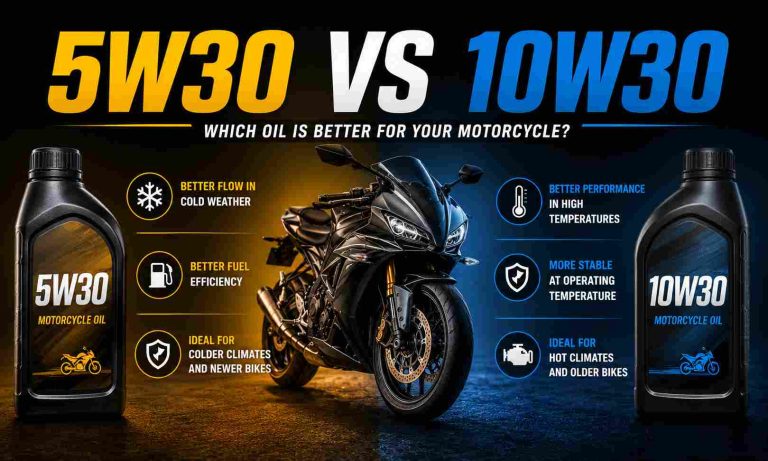
Many people see a grade like 10W-40 on oil bottles. It is a big mistake to think all 10W-40 oils are the same. The grade only tells you how thick the oil is. The “10W” tells you how it flows when it is cold. The “40” tells you how it flows when it is hot (100°C). It does not tell you if the oil is normal or man-made (synthetic). It also does not tell you what additives are in it. The additives are what make the oil work well.
Bikes often need thicker oils, like 10W-40 or 20W-50. This helps protect parts when it is very hot. New cars often use thinner oils, like 5W-30 or 0W-20. Thinner oil helps cars use less gas. A thin car oil might not be strong enough to protect a bike’s gears. So, two oils can say “10W-40” but work in very different ways.
Additives That Make Oil Slippery
The biggest chemical difference is the use of friction modifiers. New car oils have these. You can see “Energy Conserving” on the label. These additives make parts very slippery. This helps the car save gas.
These slippery additives are very bad for a bike’s wet clutch. A wet clutch needs some friction to work. When you let out the clutch lever, the plates inside press together. The oil must let them grab smoothly. This is called “clutch feel.” When the lever is all the way out, the plates must lock tight. This sends all the power to the wheel.
The slippery additives in car oil coat the clutch plates. This makes them too slippery to lock up. The clutch will slip. This can make the bike slow. It can also make the clutch get very hot and break. Because of this, bike oils are made without these slippery additives.
Oil Must Be Strong for Gears
Oil must keep its thickness even when under stress. This is very important for bike oil. It is because the oil also has to protect the gears. Multi-grade oils use tiny parts called VI Improvers. These parts help the oil keep its thickness when it gets hot.
In a bike, the oil is squeezed between the gear teeth. This is a lot of force. It can cut the VI Improvers into small pieces. When this happens, the oil gets thin. A 10W-40 oil can become as thin as a 10W-30 oil. A thin oil does not protect the gears well. This can cause them to wear out.
Bike oils are made with stronger VI Improvers. They can handle the stress from the gears. Car oils do not have to protect gears. So they are not made to be this strong. They will break down fast in a bike.
Zinc Helps Stop Wear
An additive called ZDDP has been used in oil for a long time. It has zinc and phosphorus. It is very good at stopping parts from wearing out. When parts get hot and are under a lot of pressure, ZDDP forms a thin, hard film. This film keeps metal parts from touching each other.
New car rules have changed how much ZDDP is in car oil. The phosphorus in ZDDP can harm a car’s catalytic converter over time. To protect this part, new car oils have less ZDDP. This is okay for new cars. They have parts that do not need as much protection.
Bikes work harder. They can use the extra wear protection from more ZDDP. So, bike oils often have more ZDDP than car oils. Car oil is made to save gas and protect the exhaust. Bike oil is made to protect the engine and clutch. These are opposite needs.
This table shows the key chemical differences.
| Additive | Job | In Car Oil | In Bike Oil | Why It Matters |
| Friction Modifiers | Saves gas | Yes, a lot | No, or very little | KEY: Car oil additives make a bike’s clutch slip and fail. |
| Anti-Wear (ZDDP) | Stops wear | Less | More | Car oil may not protect bike parts enough. |
| VI Improvers | Keeps oil thick | Made for engine stress | Made to be very strong | Car oil gets thin fast from bike gear stress. |
| Detergents | Keeps engine clean | Yes | Yes | Both oils keep engines clean, but are made for different needs. |
| Corrosion Blockers | Stops rust | Yes | Yes, a lot | Bikes are often stored, so they need good rust protection. |
How to Read Oil Labels
Oils are very different. So how do you pick the right one? You can look at the labels. Groups around the world create standards. These are not just for ads. They tell you what the oil can do. There are separate standards for bikes and cars. This proves they are not the same. Learning to read these labels is the best way to keep your vehicle safe.Bike Oil Labels (JASO)
The JASO T903 standard is the main one for bike oils. JASO stands for Japanese Automotive Standards Organization. This standard was made because new car oils were hurting bikes. The main job of the JASO T903 standard is to test if an oil is safe for a wet clutch.
Oils are tested to see how they work with a clutch. The test looks at three things :
- Dynamic Friction: How the clutch feels as you let out the lever.
- Static Friction: How well the clutch holds when locked.
- Stop Time: How fast the clutch locks up.
Based on these tests, an oil gets one of four grades:
- JASO MA: This is the basic grade for wet clutches. It is safe to use. It works for the engine, gears, and clutch.
- JASO MA2: This oil has higher friction than MA. It gives a stronger grip in the clutch. Many new, strong bikes use it. The clutch may feel more direct.
- JASO MA1: This is a lower friction grade. It is still safe for wet clutches. If an oil is part MA1 and part MA2, it is just called MA.
- JASO MB: This oil has the lowest friction. It has friction modifiers to save gas. It is only for scooters or bikes with dry clutches. Do not use JASO MB oil in a wet clutch. It will make it slip.
Car Oil Labels (API and ILSAC)
The labels for car oils are set by two groups. One is the American Petroleum Institute (API). The other is the International Lubricant Standardization and Approval Committee (ILSAC). Their labels show that the oil is good for saving gas and protecting the exhaust.
- API: The API “Donut” symbol is on the back of the bottle. It shows the oil’s thickness grade and its API Service Category.
- Service Category: “S” is for gas engines (like API SP). “C” is for diesel engines. A newer “S” grade is better. It can be used in older cars. New grades protect new engines from new problems.
- Resource Conserving: If you see “Resource Conserving” on the Donut, it means the oil has friction modifiers. This oil is not safe for a wet clutch.
- ILSAC: ILSAC is a group of car makers. An ILSAC grade (like ILSAC GF-6A) is even stricter than the API grade. It must pass more tests for saving gas.
- API “Starburst”: If an oil meets the ILSAC standard, it can have a “Starburst” symbol on the front. This symbol means the oil is good for a modern car. It also means it is “Energy Conserving” and must not be used in a bike with a wet clutch.
- API “Shield”: There is a new “Shield” symbol for very thin oils (like 0W-16). It is not for older cars.
The labels show the different goals. JASO tests for enough friction. ILSAC tests for low friction. The label on the bottle is the best way to know what the oil is for.
This table helps you read the labels.
| Label / Logo | Group | For | Main Goal | Good for Wet Clutch? |
| API “Donut” (SP) | API | Cars (Gas) | Protect engine parts | NO (if it says “Resource Conserving”) |
| ILSAC “Starburst” (GF-6A) | ILSAC / API | Cars (Gas) | Save gas, protect exhaust | NO (Always “Resource Conserving”) |
| ILSAC “Shield” (GF-6B) | ILSAC / API | Cars (Gas) | Save gas (for very thin oils) | NO (Always “Resource Conserving”) |
| JASO MA / MA1 / MA2 | JASO | Motorcycles | Safe for wet clutches | YES (Made for this) |
| JASO MB | JASO | Scooters / Dry Clutch Bikes | Low friction to save gas | NO (Will make clutch slip) |
Using the Wrong Oil
The differences in oil are real. Using the wrong oil can cause real damage. It is much worse to use car oil in a bike than bike oil in a car. The damage from car oil in a bike can happen fast. We need to think about oils by what they do, not just what vehicle is on the bottle. This helps explain why some diesel oils can be used in bikes.
What if You Use Car Oil in a Bike?
Using car oil in a bike with a wet clutch is risky. It can harm the bike’s parts.
- First Risk: Clutch Slips and Fails: This is the biggest and fastest problem. The slippery additives in car oil get into the clutch plates. This makes them too slippery to grab. The clutch will slip when you give it gas. This makes a lot of heat. The heat can bend the metal plates and ruin the clutch. For some, this happens over time. For others, it happens right away.
- Second Risk: Gears Wear Out Faster: Car oil is not made for the stress of bike gears. The oil will get thin very fast. When the oil is thin, it does not protect the gears well. The metal gear teeth can touch. This causes them to wear out. It can lead to bad damage over time. An oil that is not strong enough will not protect your bike for long.
- Third Risk: Engine Wears Out: New car oils have less of the anti-wear additive ZDDP. This is fine for new car engines. But it may not be enough to protect some bike engines. This can lead to more wear on parts like the camshaft.
What if You Use Bike Oil in a Car?
Using bike oil in a car is not a good idea either. The risks are not as bad for the engine itself.
- First Risk: Damage to Catalytic Converter: The main risk is to the car’s exhaust system. Bike oils have more phosphorus from ZDDP. This phosphorus can ruin the catalytic converter. Over time, it will stop working. This will cause the car to fail an emissions test. A new catalytic converter is very costly.
- Second Risk: Worse Gas Mileage: Bike oils do not have the slippery additives that car oils do. Using bike oil in a car will cause more friction inside the engine. This will make the car use more gas.
- Third Risk: Costs More: Bike oil costs a lot more than car oil. There is no good reason to use it in a car. It costs more and does not help.
What About Diesel Oil?
Many people use some heavy-duty diesel engine oils in their bikes. Shell Rotella T6 is one example. This is not strange. It makes sense if you look at what the oil does.
Diesel oils are made for hard-working diesel engines. These engines are hot and put a lot of stress on the oil. So, diesel oil is made to be like bike oil in some ways:
- It Is Strong: Diesel oil is made to keep its thickness under stress. This is good for a bike’s gears.
- No Slippery Additives: Diesel oil is made to be tough, not to save a little gas. So, many diesel oils do not have the slippery additives that hurt wet clutches.
- JASO MA Label: Many diesel oil makers have tested their oils for bikes. Shell Rotella T6 has a JASO MA and MA2 rating. This means it is approved for wet clutches.
This shows that we should not think of “Bike Oil vs. Car Oil.” We should think about what the oil does. Some oils are for “Shared Oil / High Stress / Good Friction.” Other oils are for “Separate Oil / Low Friction / Exhaust Safe.” Bike oils and many diesel oils are in the first group. That is why they can work together. New car oils are in the second group. That is why they do not work in bikes.
How to Choose the Best Oil
If you know about oils, you can make good choices. This will help your vehicle run well for a long time. These tips will help you pick the right oil. They are based on facts, not just stories.
Always Read the Manual
The best place to find out what oil to use is your owner’s manual. The people who built your engine know what it needs. If you use the wrong oil, it might not work as well. It could also void your warranty.
The manual will tell you two key things:
- SAE Viscosity Grade: This is a number like 10W-40. There may be a chart that shows what grade to use for the weather where you live.
- Performance Standard: This tells you the quality of oil you need. For a bike, it will be a JASO grade (like JASO MA). For a car, it will be an API or ILSAC grade (like API SP).
Following the manual is the safest and best way to choose an oil.
A Guide for Picking Oil
Here is a simple way to choose an oil at the store:
- Check Your Manual: First, find the grade and standard your vehicle needs.
- For a Bike with a Wet Clutch (Most Bikes):
- Look for JASO: Find the JASO MA, MA1, or MA2 mark on the bottle. This is the best sign that it is safe for your clutch.
- Avoid Car Labels: Do not buy any oil with the API “Starburst” or “Shield.” Do not buy oil that says “Energy Conserving” or “Resource Conserving.” These oils have slippery additives that will hurt your clutch.
- Check the Grade: Make sure the JASO MA oil has the right thickness (like 10W-40) for your bike.
- For a Scooter or a Bike with a Dry Clutch:
- Check the manual. It might say to use a JASO MB oil to save gas. A JASO MA oil is also safe to use.
- For a Car:
- Look for API/ILSAC: Pick an oil that meets the standard in your manual (like API SP).
- Match the Grade: Make sure the oil has the right thickness for your car and the weather.
- Do not use bike oil. It does not help, costs more, uses more gas, and can harm the exhaust system.
FAQs for Motorcycle oil vs car oil
Can I use car oil in my motorcycle?
It is not a good idea to use car oil in your motorcycle. Car oil has additives that can make your bike’s wet clutch slip. This can lead to poor performance and damage.
What is the main difference between motorcycle oil and car oil?
Motorcycle oil must protect the engine, gears, and clutch all at once. Car oil only protects the engine. Car oils also have slippery additives that are bad for bike clutches.
Is 10W-40 car oil the same as 10W-40 motorcycle oil?
No, they are very different. The 10W-40 label only tells you the oil’s thickness. The special additives inside are made for very different jobs in bikes and cars.
What happens if I use car oil in my motorcycle?
Using car oil can cause serious issues for your bike. The most common problem is clutch slippage, which can lead to damage. It can also cause your engine and gears to wear out faster.
Can I use motorcycle oil in my car?
You should not use motorcycle oil in a car. It costs more and does not help performance. Over time, it could also harm your car’s catalytic converter, which is an expensive part to fix.
Fake Oil vs. Real Oil
You can choose between normal oil and man-made (synthetic) oil.
- Normal (Mineral) Oil: This oil is made from crude oil. It is the cheapest. It works fine for normal use if you change it on time. But it does not handle heat as well.
- Synthetic Oil: This oil is made in a lab. It is made to be better than normal oil. It has many good points, especially for hard-working bikes :
- Handles Heat Better: Synthetic oil does not break down in high heat. This is great for hot air-cooled engines and fast sport bikes.
- Stays Thicker: It is stronger and keeps its thickness longer.
- Works Better When Cold: It flows easily when it is cold. This helps protect the engine right after you start it. A lot of engine wear happens in the first few seconds.
Synthetic oil costs more. But it protects better. This can make it worth the cost if you ride hard or want your engine to last a long time. The best thing to do is use the best oil you can afford that meets the rules in your manual. And always change your oil on time.
Final Words
I learned the hard way that the right oil is key. My bike’s clutch felt terrible with the wrong stuff. Using proper motorcycle oil made my shifts feel smooth and new again. Give your bike the care it needs. A happy engine makes for a much better ride.